Comparing Arenas of Thriving
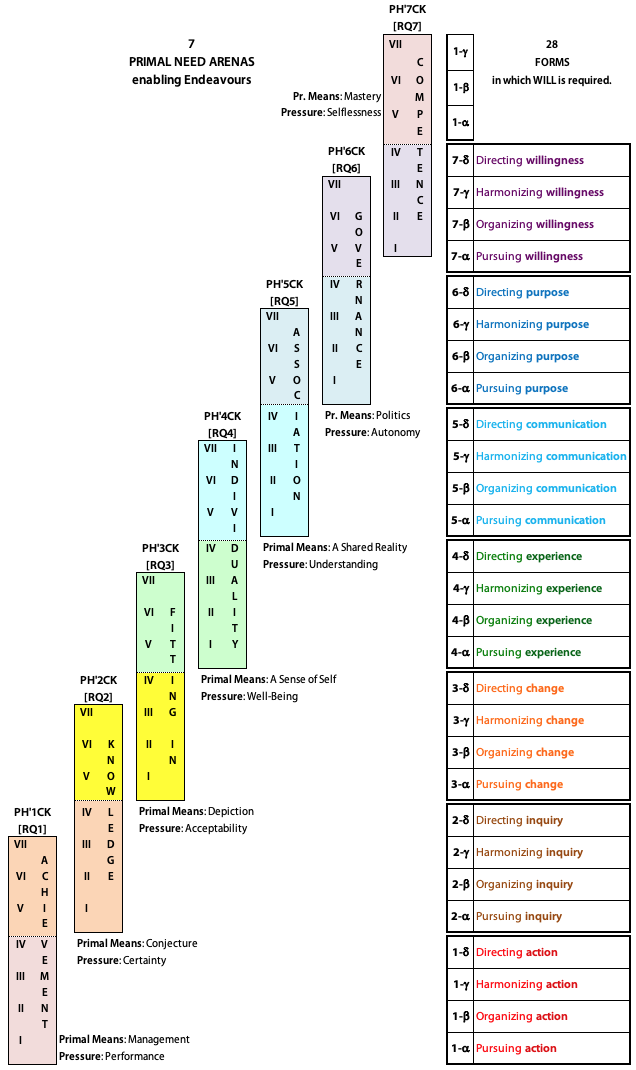
The 7 Arenas based on Primal Needs that emerge from the Levels of Will were explained in the previous topic. Click on the thumbnail at right to see them again.
These Arenas clearly influence each other. We can examine this using both a TET layout in this topic, and a Tree pattern in the next topic.
Arena TET Analysis
The other Domain Arenas were plotted on a TET to reveal a standard pattern. It seems reasonable to apply this pattern to the Root Arenas and test it by examining:
a) whether it rings true in terms of the quadrant pairings
and
b) whether axes can be determined and are illuminating
and
c) whether the usual quadrant properties can be identified.
In the diagram. the Root Arena primal need label is elaborated with the primal means.
Pairing
The imposed layout is shown at right with primal means indicated, and it reveals that pairing makes sense.
LL Quadrant: enables .
UL Quadrant: enables .
UR Quadrant: enables .
LR Quadrant: —local enables societal (and vice versa).
Axes
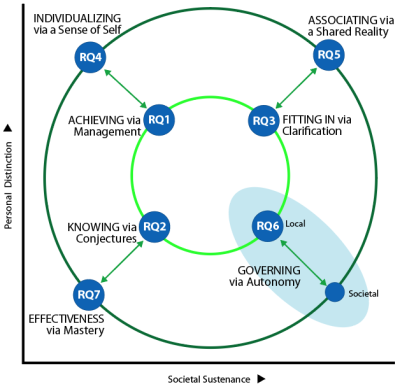
In THEE, the X-axis is always the social output: in this case the output that flows from thriving. This is proposed as group sustenance i.e. if individuals thrive then the society will thrive.
It is evident that and are very high on societal sustenance, and that and are moderately high.
Whereas and can contribute to society but not necessarily very much. While and have minimal societal effects.
In THEE, the Y-axis is always the psychological requirement for the output: in this case the requirement for sustaining society. This is proposed as personal distinction i.e. if individuals distinguish themselves, then they are likely to sustain society.
It seems that and are very high on personal distinction, and that and are moderately high.
and involve only a low amount of distinction, while and are extremely similar for everyone and therefore are very low on this axis.
Quadrants
Having established the TET parameters, it is possible to consider whether the usual patterns are present.
The inner circle contains Arenas which are more specific and unambiguous;
while
the outer circle contains Arenas which are more general and contextual.
is in both circles with contextual and specific forms.
Diagonally opposite quadrants are potentially antagonistic or opposing.
In this case:
UR Arenas focus on handling groups, while LL Arenas focus on handling tasks.
UL Arenas is demonstrative, while the LR Arena is restraining.
Originally posted: 26-Jan-2026.