Review: A Serious Involvement
Summary
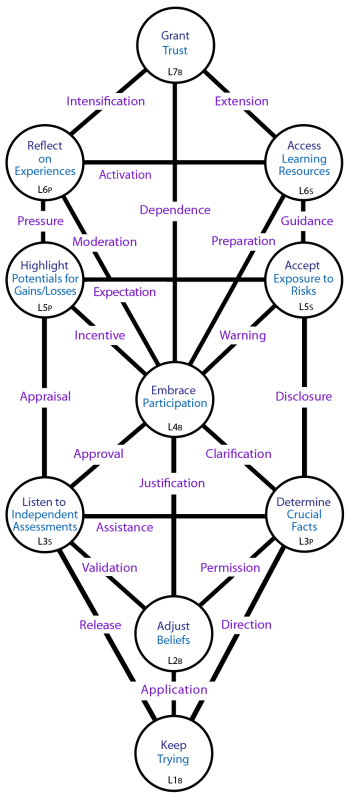
is about bringing positivity and energy into endeavours. Looked at independently apart from any specific endeavour, it appears to be about a sense of being involved and committed to dealing with a challenging situation without having any particular plan of action or certainty of success.
The lowest 3 levels appear to demand a degree of courage: the courage to try, the courage to use personal beliefs, the courage to face realities. Add in participation, and the lower pole of the internal duality can be described as a «courageous involvement». This pole assumes your presence in the situation.
The upper 3 levels appear to demand that the involvement becomes a «serious commitment»: initially despite risks and with the expectation of some tangible or intangible gain or manageable loss, then through continuous reflection and periodic systematic learning, and finally via a trust that involvement is right. This pole assumes continuance of participation.
Example: Politics
To bring this framework to life, let us apply it to politics.
Starting again at . You have become aware of the importance of politics and you want to become involved. So the first question is how and where are you going to participate. Whether your interest is in local politics, in governance of wider society, or in geopolitics, you need to find a group that you are eager to join and feel that you belong. It might be a political party, it might be an activist group, it might be within the media, or in academia, or some other body.
. Having found your group, you have to focus in on an area of interest or concern, where you seek out crucial facts and become aware of what others think.
Your beliefs, political and practical, that relate to this focus are then brought into play as you justify your involvement and adjust them to adapt to situations.
in accord with the facts as you see them and your own beliefs never stops because nothing is ever as it should be.
is vital: whether it is in the political process, in the value of your group, in the methods that you are employing, or in the support of your colleagues. Without this trust, enthusiastic involvement is gravely weakened.
is an ever-present reality in the world of politics, more so in some environments than others. Betrayal, sabotage, and dirty tricks are common in struggles for power. Your reputation may suffer or your efforts undermined. What enables you to accept these dangers is the potential for gains from your political activities. If you are power-centred these gains are personal wealth and status. If you are cause- or community-centred these gains are for others or posterity.
takes place as you reflect on your successes and failures. As new issues and opportunities emerge you find it natural to study, attend seminars or workshops, and benefit from the experiences of others.
Self-Centredness
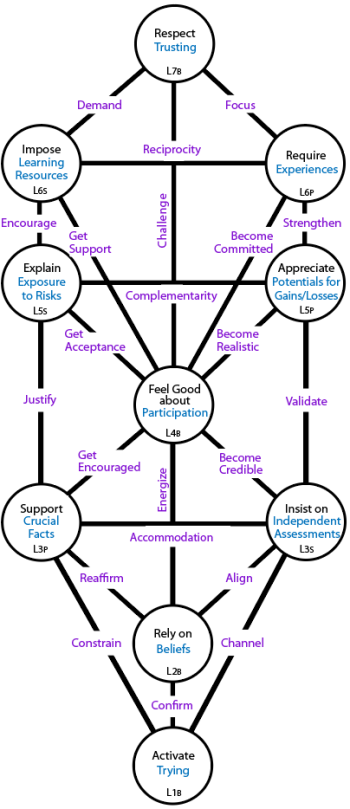
Willingness is driven by selflessness, but most endeavours are self-interested. There is no paradox here: once you decide on your endeavour, that is to say its goal, then you have to submit to that goal. The goal takes on an independent existence and who knows where its pursuit may take you. That pursuit needs to be selflessly powered or you would stop or give up every time something was unpleasant or demanding.
However, the present focus is on becoming seriously involved and it is necessary to distinguish what is requisitely required in being serious, from a more self-centred handling of involvement. A different, but standard, pattern of verbs and inter-level influences applies in this case, which usually generates a significantly different feel to involvement.
Starting again at , it is necessary to feel good about . It was never sufficient to participate out of duty or under pressure: it had to be gladly embraced. Here the force for well-being is re-emphasized and potentially generates inappropriate expectations (cf. dating).
In the lower section, is activated, so no change there either. Only differ somewhat as there is now an increased reliance on these.
However, at , there is greater emphasis on independent assessments (), probably because there is a feeling of safety in shifting responsibility or moving with the consensus. No-one will really blame you if you are wrong just like everyone else, and it is easy to feel better by blaming advisors when efforts fail.
In the upper levels, there is a greater sensitivity to personally-controlled Centres. So in relation to , greed and loss aversion () have a greater impact than a rational approach to risk exposure (). In regard to , there is a marked preference for first-hand experience rather than dependence on formal learning and textbook knowledge.
With regard to , you are aware both of how important trust is and how fragile as well. So you respect trust, but learning about situations becomes more important as you seek to protect yourself. While you respect trust, it challenges your participation and you remain wary of how matters will work out in practice.
In summary: a self-centred approach to serious involvement is similar but more cautious than the requisite approach. There is a tendency to be more focused on gains, to look outside of yourself for guidance, while claiming a risky right to give your own experiences priority over established knowledge.
Involvement is not a one-way street: sometimes it does not work out.
- Involvement not working out? Consider painful disengagement.
- Get involved or not? Review the dating dilemma.
() will precede many highly valued endeavours where willingness cannot be taken for granted.
However, there is a particular challenge where willingness plays the dominant role. This is where the situation must be improved, perhaps because it is dire or the need is great, but the difficulties and dangers make efforts seem impossible.
The components required when can be analysed as combinations of willingness elements. This framework is a structural hierarchy and it will be considered in the next section of this satellite.
- Willingness in extremis.
Originally posted: 6-Jun-2026.