Serious Commitment
Staying the Course
The challenge has been accepted. and the lower Centre-states of willingness that generate a personal involvement have been activated.
While a challenge may be interesting initially and taking it on feels exciting, the hardest part is to stay the course despite difficulties, failures and the emergence of seemingly insurmountable obstacles. That raises the question: is the embrace of participation a serious commitment?
It will be if participation is bolstered by taking steps to stay involved. Such persistence entails:
- addressing the risk () of depleting precious resources for little or no gain,
- being determined to learn () from mistakes and failures,
- consciously trusting (L7) yourself, others and the process on which you have embarked.
L5: Risking
Centre(s)
As soon as is activated, questions emerge like "what am I risking?" and "what gains or losses are likely?". Risking for gain will buttress my involvement—but only if potential losses are within my risk tolerance. Losses may be tangible like cash or goods, social like status or reputation, or personal like wasted time and lost opportunities. Gains too can be tangible (like cash or goods) or intangible in the form of expanding contacts, enhancing reputation, maintaining integrity, increasing self-esteem and just feeling good.
Dynamic Duality: Risking generates two polarized but connected Centres in the Tree: and .  Why?
Why?
We will label :
and label :
Channels
Accepting exposure to risks () will dominate over anticipated potentials (), because if the risks cannot be tolerated, willingness rapidly diminishes. So the Centre is dominant and placed on the right side of the Tree diagram.
These two Centres affect each other. Risks are only tolerable if you expect sufficient gains or assume losses can be limited. Similarly when you seek gains you understand that some risk is involved and must be tolerated.
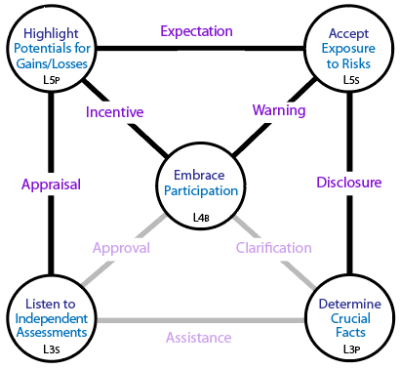
is provisionally labelled Expectation
Participation involves continuing activity with others into an uncertain future and this unknown element means that exposure to risks is unavoidable. Acceptance of exposure to risks similarly warns that embracing participation is the mechanism for possible losses.
is provisionally labelled Warning
The potential for gains makes participation seem worthwhile and incentivizes effort. Conversely participation encourages and energizes a search for possible gains or losses.
is provisionally labelled Incentive
is closely related to realities that must be , and there are potentially four Channels. However, only two are practicable: and .
With regard to unavoidable risks that must be tolerated, determination of crucial facts is what counts. The realities that you identify will reveal that you are exposing yourself to risks. Any general risk factors intrinsic to the type of challenge will direct you to uncover relevant specific realities.
is provisionally labelled Disclosure
Note: There is no direct channel. Why?
Independent assessments of the challenge will orient you to the potential for gains or losses. The search for gains will be a criterion for evaluating what independent assessments have to say about the challenge.
is provisionally labelled Appraisal.
Note: There is no direct channel. Why?
Neither nor directly interacts with or because the former are so abstract and the latter are so concrete. However, influence can be mediated by intervening Centres.
L6: Learning
Centre(s)
Involving yourself in a challenge is likely to reveal gaps in personal abilities sooner or later. You may find that you lack a specific skill or necessary knowledge, which can be remedied by education. You are also liable to make mistakes or get into difficulties for reasons that are obscure. This too must be addressed by viewing these setbacks as opportunities for learning.
Dynamic Duality: Learning generates two polarized but connected Centres in the Tree: and . Why?
We will label :
and label :
Channels
in handling the challenge is a private matter whose results are uncertain. By contrast, are definitive and your access is evident to others who will expect you to actually develop the missing skills or necessary knowledge. So formal learning will have the dominant influence, which means it is placed on the right side of the Tree diagram.
Reflection on your failures and setbacks will make you aware of specific deficiencies and activate a desire to access learning resources. Any learning process will also activate and support reflections on your experiences in its terms.
is provisionally labelled Activation
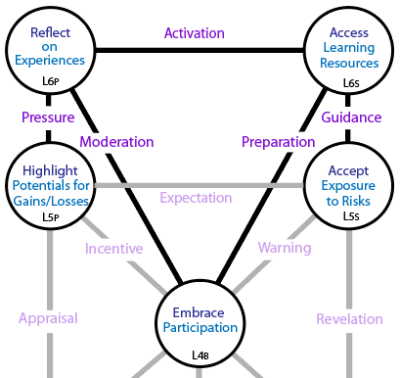
is closely related to , and there are potentially four Channels. However, only two are practicable: and .
Accessing learning resources will provide guidance on common mistakes, dangers, and other risks in applying skills or knowledge. Awareness of your exposure to risks will guide you to discover resources that help in the management of those risks.
is provisionally labelled Guidance
Note: There is no direct channel. Why?
Reflection on past experiences will create a natural pressure to envisage likely gains or losses. Conversely, any conjectured potentials for gains and fears regarding losses will press for confirmation through reflecting on your experiences of the process.
is provisionally labelled Pressure
Note: There is no direct channel. Why?
Given the situation is challenging, the embrace of participation should prepare you to learn from past history and from others in the group. Accessing learning resources might even take place before you choose to participate in order to prepare you.
is provisionally labelled Preparation
The embrace of participation acts as a point of reference and lens through which reflection on experiences occurs. Reflecting on experiences is helpful in moderating and steadying the style and extent of participation.
is provisionally labelled Moderation
Neither pole will attempt to directly influence , or without mediation by or .
L7: Trusting
Centre(s)
The complexity intrinsic to any challenging situation is far beyond the capacity of any person to grasp fully. Trust must therefore be granted blindly to get anything started. Trusting should increase as the situation evolves and more is known. Trust that progressively develops may either be specific to a person or event or nebulous in relation to the bigger picture.
Dynamic Duality: In all cases, there is a fusion of personal and social milieu factors.Why?
So, in the Tree, this level becomes a single balanced Centre: .
We will label :
Channels
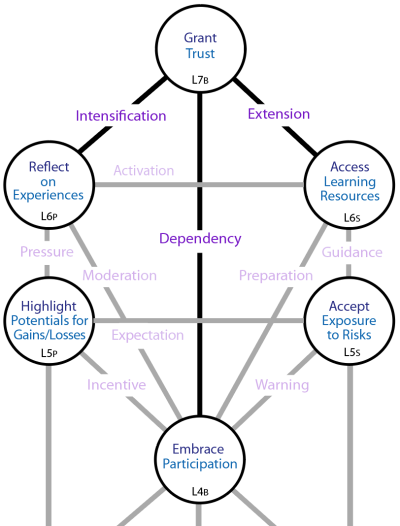
Trust in the process can be extended and broadened by accessing learning resources that remedy weaknesses and deficiencies. Conversely trust encourages learning to be extended to areas not previously appreciated.
is provisionally labelled Extension
Trust in the process can be deepened and intensified by reflecting on relevant emerging experiences. Conversely, reflection can be deepened and intensified if there is trust in the involvement.
is provisionally labelled Intensification
Trust does not directly influence risk unless mediated by or . Why?
Trusting does not operate in a vacuum: it requires substrate or focus, and that is participation. Conversely, participation depends on the grant of trust or it will not be embraced.
is provisionally labelled Dependence.
Trust remains important but it is too abstract and nebulous to directly interact with , or . Influence is most directly mediated by the evocation of .
That completes a framework required in everyday life when all levels of willingness naturally get activated and influence each other.
- Review the complete framework for serious involvement.
Originally posted: 6-Jun-2026.