Courageous Involvement
The Challenge
A participatory response to a stimulating idea, person, situation or event, does not tell you whether it will be worth becoming seriously involved, or whether you have the capability to rise to the challenge.
A courageous involvement means that your initial is specifically activated leading to you becoming embroiled for better or worse.
To determine this involvement, initial steps are:
- face the likely reality () of the challenge,
- ensure the relevance of beliefs , and
- have a go and see what you can make of the opportunity.
L3: Facing
The moment that the choice to participate and potentially get involved has been made, the need to face up to the reality of that challenge emerges.
There will be some idea of what is involved from past experiences, reading, advice and hearsay. But you are a unique person and this is a new situation. So how you see it matters. It is easy to deny or distort realities to fit what you expect or hope for, or to make yourself more comfortable. But this is not the route to a good result.
Note that you are not directly taking any risk at this level. You are solely concerned with grasping the reality and ensuring its depiction is reasonable and acceptable. To add to the difficulty, reality often has to be depicted and evaluated in terms of probabilities, and most of us are not good at that.
Centre(s)
Dynamic Duality: Facing reality will generate two polarized but connected Centres: and . Why?
Why?
We will label :
and label :
Channels
Whatever the outcome of your participation, you cannot blame others. So, valuable as their assessments and advice may be, the main consideration must be your own determination of the reality. You must focus on critical facts that will shape whether and how you participate. In doing so, you can allow yourself to be influenced by independent assessments.
This means the Centre is dominant (i.e. placed on the right side of the Tree), and a channel between the two polar is necessary. Listening to others helps you determine the essential facts, and your determination of what is important will help you select, listen and understand the perceptions of others.
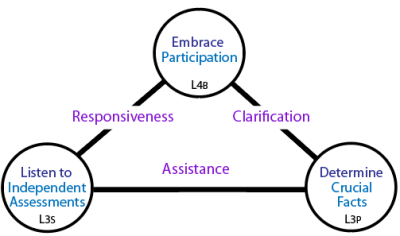
is provisionally labelled Assistance
:
There are two possible Channels here. and
Your participation in the challenge will help focus your attention on relevant facts, increasing precision in appreciating their nature and impact. As you become clearer about the crucial facts, you will be able to clarify and adjust your participation to suit your awareness.
is provisionally labelled Clarification
Participation will bring you into contact with a variety of people who are familiar with this challenge and whose views are approved. You will seek their views to get reassured and possibly to adjust your participation. The reverse influence is also likely in that independent assessments will approve the rationale of your participation.
is provisionally labelled Approval
L2: Believing
Centre(s)
A person approaches every situation with a variety of existing beliefs, but they cannot be applied to any and every challenge. That would be a form of dogmatic egocentric imposition—a far cry from positive selfless willingness. What is needed is for beliefs to be willingly adjusted according to the challenge.
Dynamic Duality: In all cases, there is a fusion of personal-private and socio-situational factors.Why?
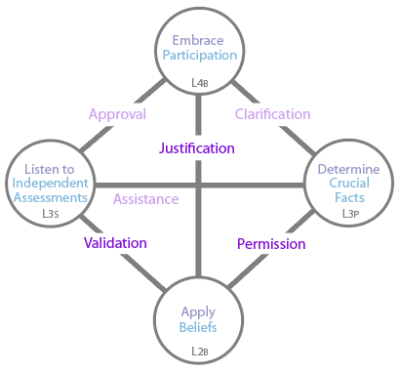
So, in the Tree, this level becomes a single balanced Centre: .
We will label :
Channels
Beliefs are naturally adjusted to justify to oneself participating in any challenge. The choice to participate similarly requires, explains and justifies adjustments to beliefs.
is provisionally labelled Justification
There are potentially two Channels here. and
Beliefs are always used in the selection and valuation of facts: sometimes forcing denial but often enabling a clearer or more relevant perspective. Determination of crucial facts will allow beliefs to be adjusted sensibly. Alternatively the facts could inhibit or block the application of beliefs.
is provisionally labelled Permission
The independent assessment of relevant realities can similarly endorse or validate the application of beliefs to the situation. Beliefs, in turn, will be used to validate the appropriateness or even correctness of independent assessments.
is provisionally labelled Validation
L1: Trying
Centre(s)
Applying and exposing beliefs may take courage, but the most concrete expression of courage and demonstration of willingness is shown by trying to make a difference when it is not at all clear this will be effective.
Dynamic Duality: In all cases, there is a fusion of personal and socio-situational factors.Why?
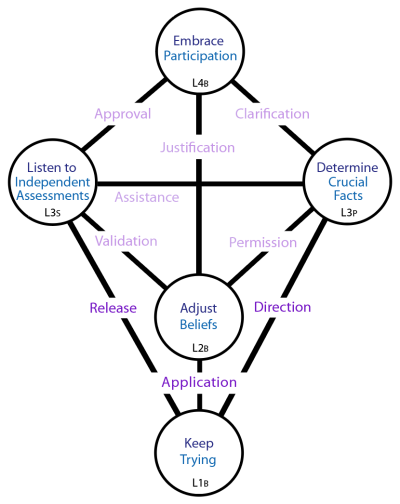
So, in the Tree, this level becomes a single balanced Centre: .
We will label :
Channels
There are potentially two Channels here. and
The facts that you determine in relation to the challenge will direct your attempts. At the same time, your attempts, successful or not, will bring certain realities of the challenge to the fore and direct your attention to taking them into account.
is provisionally labelled Direction
Independent feedback and assessment of the reality will ideally legitimate your attempts and release your efforts. Either that or they will be discouraging. Keeping on trying will likely stimulate a search for independent assessments.
is provisionally labelled Release
Relevant beliefs are automatically applied, but as you keep trying beliefs get adjusted, often in a small way, but sometimes a wholesale change in perspective is required. At the same time, as you adjust beliefs, possibly based on facts or advice, then the way you keep trying will change. In applying yourself, you do so via what you know and how you act, and these two states interact.
is provisionally labelled Application
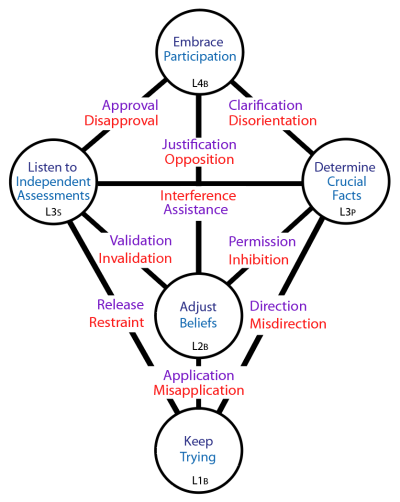
Participation does not directly affect trying or vice versa because any influence must be mediated by or by . Without those mediating centres there would be no external or internal checks on why trying and participation are occurring, nor whether involvement makes any sense.
Blockages
The lower Centres and Channels are about getting yourself involved with a particular challenge. The influences amongst the lower 3 levels are where blockages to involvement emerge rather easily.
Instead of the application of sensibly adjusted beliefs, beliefs may be dogmatically misapplied.
Independent assessments of the challenge may restrain your attempts instead of releasing them, and invalidate rather than validate your beliefs.
Your view of the facts may misdirect your efforts and inhibit the application of your beliefs.
Your views may interfere with listening to others, and the assessments of others may interfere with forming your own thoughts.
However, there can also be bi-directional problems above , where approval may become disapproval, clarification may become disorientation, and justification may become opposition.
Having clarified how involvement manifests and demands courage, it is possible to consider how it is buttressed by the higher levels of willingness.
- Centres of serious commitment.
Originally posted: 6-Jun-2026.