Just say: Yes!
Taking on a Challenge
Differences in focus were previously found when actualizing within a domain:
focused on an «issue»,
focused on a «question»,
focused on a «situation».
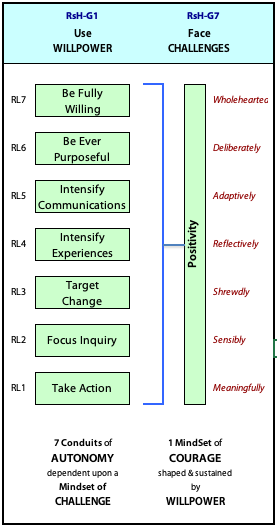
is about transcending and this too needs a stimulus or focus around which it gets developed. In practice, this might be an idea that springs into your head, an event, an obstacle, a relationship, a situation in which you find yourself, a proposal from another, or something else.
I propose to label the focus as a «challenge». The generation of positivity by facing challenges (RsHG7), as shown at right, aligns with the inherent positivity of the Willingness Domain.
Willingness becomes a field of functioning when the self-interested self-preservative reflex is to say "No"—possibly very sensibly given the difficulty, unpleasantness or danger in the challenge. Each willingness element has been partly identified in terms of this avoidance—the italicized part of the function specification.
Overcoming egotistic tendencies and saying "Yes" therefore creates a focus on the challenge. The question then arises of how your willingness develops as you engage with that challenge.
You can get yourself oriented to the sense of challenge by keeping a few examples in mind as the investigation of willingness proceeds.
Examples  :
:
Don't let Yourself get Confused ►
Something comes along, and you have the option either to ignore/refuse it or to say "Yes!". Saying "Yes" means you want to be a part of it—of course subject to checks and reflections, but you and everyone else take that for granted. "Becoming part" is to , which is a form of willingness. So the natural place to start this exploration is because this will lie at the heart of your involvement.
Having considered , we can initially investigate L's 1-3, the three levels below, which determine whether "saying Yes!" to the challenge will turn into a courageous involvement. Then we can turn attention to L's 5-7, the three levels above, which determine whether that involvement will become a serious commitment.
The whole framework will then clarify whether and how a spontaneous "Yes!" turns into a serious involvement into which you throw all your positive energies.
L4: Participation
Challenges take place in social settings and involve other people in a variety of ways dependent on the nature of the challenge. From a psychosocial perspective, you are always participating, not just doing something.
The willingness issue is therefore not about "will you do something", but will you take part in the psychosocial process intrinsic to challenges.
Example :
For all challenges, the most prominent and immediate question is whether you are willing to let yourself become involved, to be available whenever required for the challenge. Everyone will be watching the quality of your response: are you embracing the opportunity or is it a tepid weak indication of possible interest?
In any challenge, there are many external difficulties as well as inner objections and resistances, but you are protected by an intrinsic well-being pressure—as noted in the Primary Hierarchy and also believed to be characteristic of L4 in all Trees. If your participation is genuinely willing, you will gladly welcome and embrace it.
Centre(s)
Dynamic Duality: In all cases, there is a fusion of personal and socio-situational factors.Why?
So, in the Tree, this level becomes a single balanced Centre: .
We will label :
Channels
In all previous analyses, the L4 Centre links to all other Centres except for the L1 Centre. However, we will not take the Channel pattern for granted. As additional Centres are identified, possible direct influences and interactions will be explored and, if present, named. For now, is just one Centre with potential links in all directions.
If it is indeed a challenge and you have given an initial "Yes!" to , then courage is probably required. To avoid foolhardiness, it is essential to appreciate implications that could potentially convert that initial response to "No! Never!".
- Centres of courageous involvement.
Originally posted: 6-Jun-2026.