Relation of Unfolding Dualities to Pressures in Structural Hierarchies
Research Question
Having clarified the assignment of psychosocial pressures to Structural Hierarchies, the role of its unfolding duality (uD) needs investigation.
Specifically:
How are the 1° structural pressure and 2° operating pressure at each Grouping of a Structural Hierarchy related to the dialectic process of its unfolding duality?
This is also an opportunity to clarify how unfolding dualities of Principal Typologies and Structural Hierarchies differ.
Sources of Evidence
Only a limited number of the many THEE structural hierarchies have been discovered and developed in detail, and only some of these have been investigated for unfolding dualities.
Frameworks used for this study:
| THEE Location |
THEE Name [Link to Diagram] |
Generic Unfolding Duality Ground v Challenge |
|---|---|---|
| Creativity in Endeavours | Optimism v Confrontation | |
| Producing Goodness | Natural Goodness v Moral Transcendence | |
| Realizing Values | Survival v Progress | |
| Attempting the Impossible | Fortitude v The World as It is | |
| Expectations of Employment | Comfort v Ambition | |
| Political Life in Society | Continuity v Change | |
| Organising Management | Confidence v Pressure | |
| Looking Out for Yourself | Self-Assertion v Psychosocial Realism |
All sources apart from and were developed prior to conjecturing the existence of psychosocial pressures.
Difference from Typologies
From the investigation of dialectic unfolding dualities in Principal Typologies, it became evident that both poles are intrinsic to the Type, and the poles oppose, compete and generate social polarization. Although the uD's structure and pressure pattern imply a progressive, developmental and cyclic process, this is a purely taxonomic finding—Typologies lack these qualities in practice.
Structural hierarchies are explicitly developmental and cyclic in practice, and the pressure pattern is in accordance. So the dialectic unfolding dualities are part of a process naturally found in practice and not simply a taxonomic phenomenon. However, the uD's relation to psychosocial pressures and to intrinsic progression within the hierarchy is currently obscure.
Reminders
Analysis of Unfolding Dualities
Examination of the unfolding dualities reveals that they are never two poles intrinsic to a grouping as found in Typologies.
The thesis-pole is evidently part of the framework's functioning, but the antithesis-pole is not. The antithesis is always something in the context that provides a condition for developmental of the thesis and is generically labeled as a «challenge».
Labels:
uD-Ground (uD-G) is the lower thesis-pole of the unfolding duality.
uD-Challenge (uD-C) is the upper antithesis-pole of the unfolding duality.
Thesis
As explained and illustrated in the above, the uD-Ground is something structurally necessary for meeting the Requirement of the grouping, and is indispensable for operation of the various groups within it. Although the uD-Ground does not perform group operations, that functioning cannot be effective without it.
While the thesis is not the essence of the Requirement, it enables, stabilizes or sustains its effects and can therefore be expected to be driven by its 1º Pressure.
Examples  :
:
Conclusion: The unfolding duality is not an add-on or simple property of a framework, but rather an essential component, an indispensable sustaining condition for the framework to function. Any presentation of a structural hierarchy without a formulation of this structure leaves an important dimension undeveloped.
Antithesis
The uD-Challenge is encountered in the context of group functioning. That context may be internal/mental or external/socio-physical. The uD-Ground does not cause the uD-Challenge, but its quality makes the uD-Challenge salient.
The context-based uD-Challenge is specific, unavoidable and often predictable.
While an immediate encounter with that uD-Challenge is not required, developmentally it is expected and may eventually be unavoidable. Taxonomically, the uD-Challenge is present as a potential complementary pole available for activation.
The uD-Challenge has no agency and is conditioning, not causative.
The uD-Challenge becomes active when it is given attention and appraised in relation to the uD-Ground. This recognition creates the dialectic tension and initiates investigation, reflection or other response which increases the already operative 2° pressure that is driving the Groups.
Examples :
So the dialectic here is contextual and adaptive—the indispensable uD-Ground encounters a counter-condition, the uD-Challenge, that reveals its insufficiency and calls forth a response. This contrasts with the intrinsic polarization of a Typology where the poles may often combine.
More Examples :
Group operations, as in the above examples, can continue being driven by the 2° pressure without activating the uD-Challenge. However, once the uD-Challenge becomes salient, it must be assessed and then handled through the Groups. Because Group operation is governed by the 2° pressure, activation of the uD-Challenge leads to intensification of the 2º pressure.
Formal Justification for Asserting a Dialectic
-
The uD-Ground cannot be ignored or discarded because current functioning depends on it.
-
The uD-Challenge, once identified as salient, cannot be permanently ignored, suppressed or removed without consequence.
-
A tension develops between the specific Ground and its associated Challenge that eventually becomes recognized as serious.
-
A synthesis based on practical, contextual or structural necessity is possible to preserve what is essential in the Ground while incorporating the effects of the Challenge—and that synthesis is a qualitatively different new Ground belonging to a higher level.
Synthesis
The dialectic tension may be manageable within the grouping or possibly avoided by retreating to a lower grouping.
Synthesis is a practical resolution that becomes necessary when group functioning within the existing grouping cannot both preserve the indispensable uD-Ground and adequately handle the serious uD-Challenge. Such synthesis generates a new uD-Ground which supports and activates the Requirement at the next higher grouping.
Recapitulation
At G#, a 1° pressure drives the Requirement and the associated uD-Ground. The context then supplies an event or condition which, when given attention in relation to the uD-Ground, must be activated sooner or later as the uD-Challenge. The resulting response intensifies the 2° pressure that is already driving group operation. Synthesis generates a uD-Ground (thesis) that supports the Requirement at the next higher G, where the former 2° pressure becomes the 1° pressure.
See an AI generated diagram: does it help?
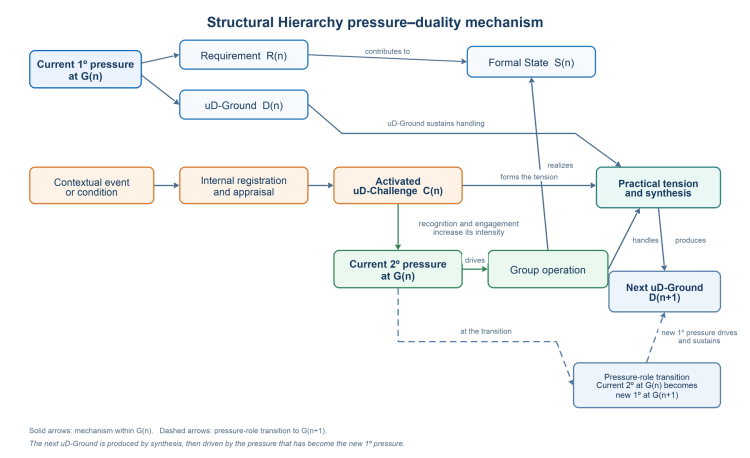
-
Now investigate oscillation in sH unfolding dualities.
Originally posted: 15-Aug-2026