5 Methods of Engagement
Orientation
You have put yourself out there and got a positive response. Now you want to take it further and deepen the engagement with the other party.
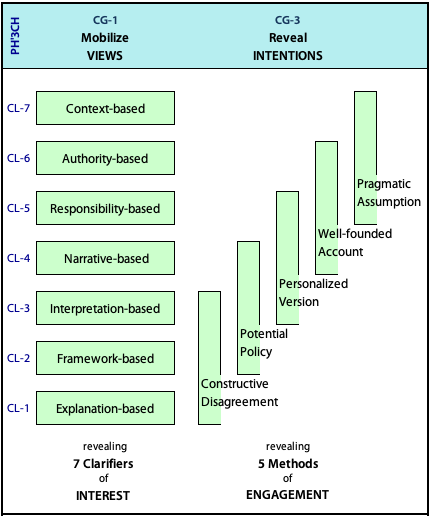
When you engage, it is necessary to know how to engage and what to look for in relation to compatibility issues. Simultaneously you must appreciate that the other party has the same concerns.
Remember: The function of is to interact more intensely so as to enliven a relationship.
While each has its own qualities and significance, in all cases values and objectives can manifest, which is critical because sharing these grounds compatibility.
CG31: Constructive Disagreement
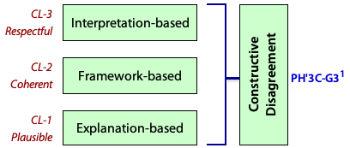
Function: To present a different view in a respectful, coherent and plausible fashion.
It is assumed that others will often have views different to mine.
A disagreement is a that reveals a , but for compatibility the disagreement must be constructive—which means expressed in a respectful and positive fashion. However, an argument must have a plausible base, show a coherent logic and respect elements that are more speculative and interpretive.
Significance: This process ensures differences of view are tolerated, and so provides the basis for issues to be worked through and potentially resolved.
In this way, values and possibly objectives on both sides become clearer.
CG32: Potential Policy
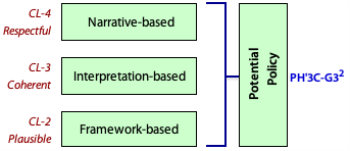
Function: To suggest a worthwhile feasible adjustment to the current trajectory of the situation.
It is assumed that others will have ideas for alternative policies.
Policies are inherently divisive () and draw on historical processes (), which is why they must be offered respectfully. The policy calls for an interpretation of events and acts as a framework for decisions. It reveals your values and goals, and by engaging with the narrative brings the other party's values and goals into awareness.
Significance: This process creates a focus on choices and activities, and enables discussion about alternative futures.
In this way, values and possibly objectives on both sides become clearer.
CG33: Personalized Version
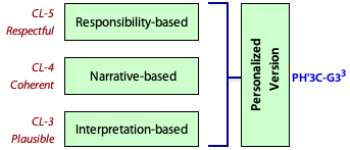
Function: To provide a personal reading of a situation.
It is assumed that others will have their own versions that differ in some ways from mine.
Any version of a situation naturally combines a view of the past (i.e. historical lessons ) and a view of the future (i.e. chosen developments ). That "version" is also an interpretation, which needs to be plausible to be accepted. As my responsibility, the version is personalized, because I treat my own views with respect. A personalized version also has to be coherent, and this follows from its narrative quality.
Significance: This process calls for personal involvement and allows you to express your own outlook and convictions and compare them to those of others.
In this way, values and possibly objectives on both sides become clearer.
CG34: Well-founded Account
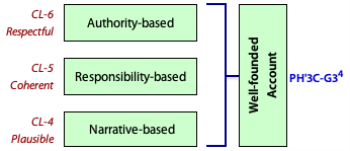
Function: To take a position based on established sources and standards.
It is assumed that others will know about your preferred account but may appeal to other authoritative accounts.
An account is a plausible narrative which draws on legitimate presumptions () and assumes chosen developments (). If you are responsible, then the account must be coherently constructed by respecting appropriate authorities (e.g. formal reports, established research, eye-witnesses).
Significance: This process identifies a shared point of reference, and fosters the use of external authorities in reaching mutually acceptable conclusions.
In this way, values and possibly objectives on both sides become clearer.
CG35: Pragmatic Assumption
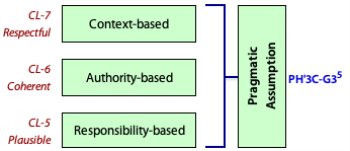
Function: To take something as a given because the situation calls for it.
It is assumed that others may well share in that assumption, but could appeal to alternative assumptions.
An assumption in use is a legitimate presumption () whose use can be authorized () by relevant circumstances. Applying pragmatic assumptions requires a responsibility that is plausible and a respect for the context. To resist challenges, any pragmatic assumption must also draw coherently on an appropriate authority.
Significance: This process responds to the shared situation so that whatever is said or done can be properly adapted to exigencies.
In this way, values and possibly objectives on both sides become clearer.
Summary Table
| CG3 | Name | Function | Significance |
|---|---|---|---|
| 5 | Pragmatic Assumption | To take something as a given because the situation calls for it. | Responds to a shared situation. |
| 4 | Well-founded Account | To take a position based on established sources and standards. | Identifies a shared point of reference. |
| 3 | Personalized Version | To provide a personal reading of a situation. | Calls for personal involvement. |
| 2 | Potential Policy |
To suggest a worthwhile feasible adjustment to the current trajectory of the situation. | Focuses on choices and activities. |
| 1 | Constructive Disagreement | To present a different view in a respectful, coherent and plausible fashion. | Handles differences of view. |
 Cumulation
Cumulation of the methods of engagement is evident from the significance of each. So:
In , handling differences of view is the foundation of any working relationship.
In , decisions and plans also require handling differences.
In , personal involvement requires clarity on decisions and plans, as well as handling differences of view.
In , shared points of reference require personal involvement, focusing on choices and activities and handling differences of view.
In , responding to a shared situation requires common points of reference, personal involvement, decisions and plans, and handling differences of view.
Transition
In regard to clarifying compatibility, the initial two groupings set the scene: required you to become centred on yourself, and required you to present yourself to others.
Now leads you to engage seriously and form some sort of socially meaningful relationship.
Only if and when a working relationship is established, will it become possible to see whether there is any worthwhile compatibility. So, given that engagement is successful, the next step is an assessment of the fit.
within a developing relationship is made possible by adding a fourth level to form G4-tetrads. Each tetrad will be a test that indicates whether or not a fit is present. If there appears to be a fit, then the relationship has the potential to be enjoyed and developed further.
- Continue to Assess Fit (CG4-Tetrads).
Originally posted: 6-Oct-2026.