Sources and Foci in Disclosure
Types of Declaration
provide the foundation for , and this is enabled by combining two adjacent levels to form dyads. The 6 dyads reveal that disclose your views and expose you.
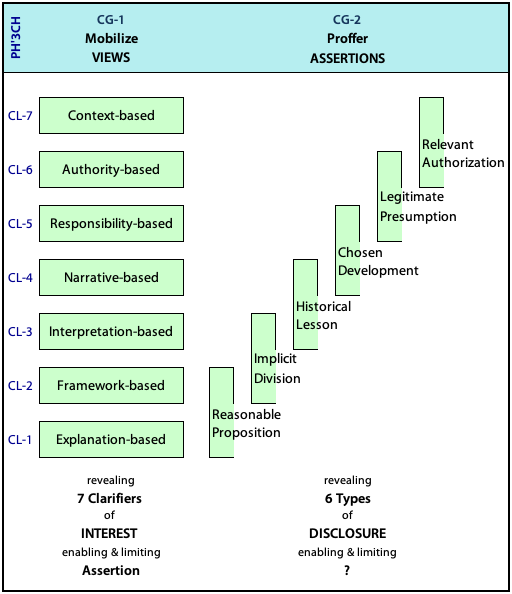
The can be named as follows:
In each dyadic declaration:
- the upper Level is intrinsically general and must be coherent so as to provide intelligibility and strength.
- the lower Level is intrinsically particular and must be plausible so as to provide clarity and credibility.
Source
The naturally fall into two sets according to the source:
- The 3 lower dyads
i.e.
each assert something about the situation as it is now and draw on your reading of the world. - The 3 upper dyads
i.e.
each assert something about future handling and draw on what is given and already exists.
Within each set of three, the dyads' source moves from personal through interpersonal to impersonal as follows:
- Personal: is your construal and conclusion, while is based in your values.
- Interpersonal: is about another or a group, while operates between parties.
- Impersonal: is based in past events shared by all, while is based in an appropriate authority, externalized or internalized by all.
Focus
The also naturally fall into three sets with a progressive focus as the sets are ascended: from situational (present), to temporal (past & future), to justification (guidance).
- The lower set of 2 dyads focuses on the existing situation: initially what is explicit or revealed, and then what is implicit or concealed.
- The middle set of 2 dyads focuses on the temporal reference: initially what could be learned from the past and then what could be enabled in the future.
- The upper set of 2 dyads focuses on justification: initially what is intrinsically legitimate and then what is extrinsically authorized.
Summary Table
| CG2# | Name | Function | Source | Focus | Exposure |
|---|---|---|---|---|---|
| 6 | Relevant Authorization | To propose that what applies in a particular situation is backed by an appropriate authority. | Impersonal | Justification: extrinsically authorized. |
Your assessment of what the situation calls for; your appreciation of what authority fits and how it should be used. |
| 5 | Legitimate Presumption | To propose a socially recognized rule or way of functioning that no-one should reject without good reason. | Interpersonal | Justification: intrinsically legitimate. |
Your awareness of standards and conventions and reliance on past experiences with these. |
| 4 | Chosen Development | To propose a feasible future state of affairs that incorporates personally desirable values. | Personal | Temporal reference: to the future |
Your attunement to realities and practicalities; your current priorities and desires, and how these fit together. |
| 3 | Historical Lesson | To propose that guidance for the future should be based on events in the past. | Impersonal | Temporal reference: to the past |
Your position on past events may be biased or controversial, and your implications assume values that may not be shared. |
| 2 | Implicit Division | To propose that there are two sides with the potential for polarization and conflict. | Interpersonal | Situational impact: implicit |
You may expose or embarrass the other party. You may open yourself to pressure to align. |
| 1 | Reasonable Proposition | To enable an exchange with a suggestion or conclusion that deserves consideration. | Personal
|
Situational impact: explicit |
Your grasp of the situation and the quality of your judgement. |
Transition
While were intra-psychic, personal and private, these are overt, social and public. That means that at this point you have opened yourself up to the other party. If they are not willing even to consider what you have to say, then relating is unlikely if not impossible and compatibility is not an issue.
Even if they do consider and interact with you, this can remain superficial and provide only limited guidance as to worthwhile compatibility in the longer term. There is a need for more contact and a deeper interaction to gain confirmation that there could be a reasonable fit assuming a relationship can be developed.
What seems most important in moving towards that end are your own values and goals. Your life, your identity and your well-being are driven by these, and so compatibility on such matters is vital. Naturally, the other party will have a similar outlook and, if you cultivate awareness at all, you will spontaneously seek to become aware of their intentions.
By adding an additional level and forming triads, it is possible to and allow them to be responded to, either positively or negatively.
- Continue to Reveal Intentions (CG3-Triads).
Originally posted: 6-Oct-2026.