Recent Errors in Assigning Pressures
Only taxonomic researchers are likely to find this topic of interest.
A Fertile Conjecture
I needed to explain:
► similarities between entities with similar formulae
and
► links between particular Root Levels and levels in downstream structures.
I conjectured that psychosocial pressures intrinsic to the Root Levels were in play, shaping human functioning and its representation in the taxonomy.
This conjecture has offered powerful assistance in discovering entities and offered occasional illumination. Over many years now, the identification and naming of these pressures, after some early experimentation, has been solidified.
Read more: here, here and here.
However, the projection patterns of psychosocial pressures into the various taxonomic structures does remain provisional. In that regard, a likely assignment error has been identified.
Corrections have been made to rectify the error and this topic is provided to explain what provoked the re-assignment, and to show both the old and the new arrangements.
Initial Discovery Process
The investigation of projections that led to conjecturing the existence and importance of psychosocial pressures took place in 2013-2015. Details.
Investigations of Q-arenas took place in 2020-2022 with considerable difficulty because very few Q-arenas had been worked out. The most developed were the .
Efforts to identify Arena psychosocial pressures led to some provisional conceptions, but without conviction. Further effort to clarify Q-arena structures, at least sufficiently to post them in the Taxonomy Notes took place between 2022-2024, and this provided more opportunity to review pressures. Details.
During that later period, I concluded that the pressures in aligned 1:1 with the Root Hierarchy i.e. Q1 received RL1 pressure, Q2 received RL2 pressure, Q3 received RL3 pressure and so on. This seemed to suit the Q-arenas in the other primary domains, insofar as those arenas were understood.
The problem with this conclusion was that I had to reject some assignments previously believed to be correct. The best example is . The initial assignment was performance (RL1), however the corrected assignment was certainty (RL2).
This disturbing phenomenon was resolved by recognizing that both pressures were in play, but in different ways. There was a primary (1°) pressure that related to the identity or structure-as-a-whole, and also a secondary (2°) pressure that related to the internal operations of a structure.
In , the governing board is focused on the organisation as a whole and is pressed by certainty (e.g. certainty of the budget, certainty of staffing, certainty of lawful operation, certainty of legal contracts &c). That is why Boards are viewed as risk-averse. Many regard it important to separate the Board Chairman with a guardian role from the CEO who has a delivery role. The CEO, like everyone else working inside the organisation, is driven by a pressure for performance and sees achievement as dependent on taking risks.
Applying this thinking to the remaining Q5-arenas was not easy. The 1° pressure was already assigned using the 1:1 rule that removed discretion. But appreciating the validity of that assignment not always clear.
The 2° pressure needed to be worked out from first principles in each case, and that took more effort and was more uncertain. I tried working with the various Q-complexes and settled on the as a guide. I checked those findings against Q-arenas in 4 primary domains () and was moderately satisfied with the assignations as a first attempt.
However, there was a cause for doubt based on the patterning. Patterning is a feature of THEE, but arguing from patterns is a heuristic. That means it often works but sometimes it may mislead.
The 1° pressures had the Root Hierarchy pattern and I expected that the 2° pressures and Primary-Secondary layout would either have no pattern or would have a distinct pattern. Instead there was what felt like an anomaly.
Here is the result from 2022:
| Arena | 1° Identity Pressure |
2° Operating Pressure |
Root Domain for 2° Pressure |
RL |
|---|---|---|---|---|
| Q7 | Selflessness | Acceptability | RL3 | |
| Q6 | Autonomy | Well-Being | RL4 | |
| Q5 | Understanding | Certainty | RL6 | |
| Q4 | Well-Being | Autonomy | RL7 | |
| Q3 | Acceptability | Selflessness | RL2 | |
| Q2 | Certainty | Performance | RL1 | |
| Q1 | Performance | Understanding | RL5 |
Some Warnings
As you see from the above Table, the ordering of the 2° pressures shows no pattern, but there is a strange internal pattern (identified at the time):
: Acceptability - Selflessness
reverses to
: Selflessness - Acceptability
: Well-Being - Autonomy
reverses to
: Autonomy - Well-Being
I took this as a warning that there might be an error, but did not know what to do with it except assert that all assignments were provisional, 2° more so than 1°.
There were other warnings of errors. I had been so uncertain in some assignments that I provided alternate possibilities. For example, I had proposed the 2° pressure in was selflessness (which conformed to the PH'2Q pattern) but I also noted that researchers would likely say they felt more pressed by certainty.
There were a few other examples including two more still within , and , but investigating multiple possibilities across multiple domains is exhausting and quickly becomes confusing. So, perhaps affected by the Australian summer heat or laziness, I judged it best to leave the assignments as they were and return to this puzzle in the indefinite future. Perhaps detailed substantive investigation of a particular framework might provide unequivocal clarity.
That time has now come—but not in the way expected.
Later Discovery Process
In 2024, I began a re-investigation of following a gap of almost 30 years. I had worked then on interacting-for-benefit frameworks long before TOP commenced. I now recognized these frameworks were mostly applications derived from a small part of the complex. That complex now deserved to be studied and formulated systematically.
An important part of this complex is the Q-structural hierarchy () named «».
In the initial studies of psychosocial pressure projections 10 years earlier (as described above), a pattern for 1° pressures in structural hierarchies had been identified. I wanted to check, and confirm or dis-confirm, its application in this case.
More significantly, based on the recent Q-arena studies, I asked myself whether 2° pressures might apply in structural hierarchies.
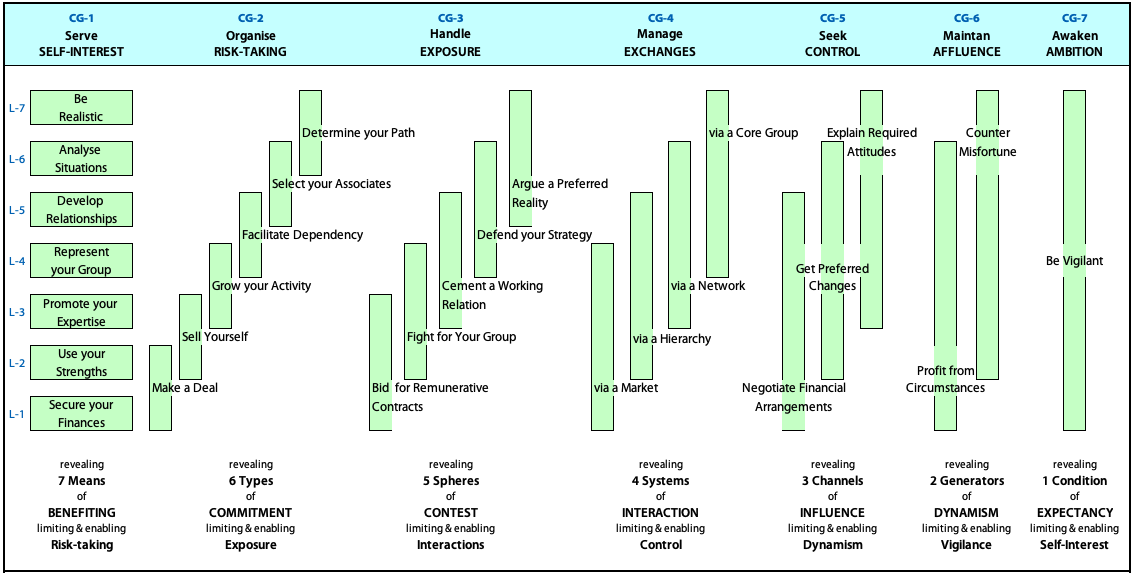
It quickly became evident that the 1° structural pressures previously identified, related to the Requirements and States, i.e. the groupings as labeled top and bottom in the diagrammatic representations: click on the thumbnail to see.
However, groupings are operated via the groups within them, and these components appeared to be driven by different pressures, presumably 2° operating pressures.
This finding needs to be corroborated via other structural hierarchies and such a check awaits implementation, but intuitively the presence of 2° pressures seemed highly likely.
In creating summaries for the Review section of «», I laid out the findings to do a pattern check, and this is how it looked initially:
| G1 | G2 | G3 | G4 | G5 | G6 | G7 | |
|---|---|---|---|---|---|---|---|
| 1°: Identity | Autonomy | Understanding | Performance | Certainty | Acceptability | Well-Being | Selflessness |
| 2°: Operation | Well-Being | Performance | Certainty | Acceptability | Selflessness | Autonomy | Understanding |
There is a clear potential pattern which I have highlighted below by using coloured cells:
| G1 | G2 | G3 | G4 | G5 | G6 | G7 | |
|---|---|---|---|---|---|---|---|
| 1°: Identity | Autonomy | Understanding | Performance | Certainty | Acceptability | Well-Being | Selflessness |
| 2°: Operation | Well-Being | Performance | Certainty | Acceptability | Selflessness | Autonomy | Understanding |
The 2° pressure of one grouping becomes the 1° pressure of the next higher grouping in 3 cases. Intuitively, that seems possible even likely because the whole structure is presented as an evolution from grouping to grouping: click on the thumbnail again and check the top and bottom rows of text.
So perhaps this pattern should apply throughout?
The 1° pressures in the top row were developed from studies of several structural hierarchies. On reviewing, there is no reason to change any of these either to support or alter a pattern. The only changes should be in the row of 2° pressures.
On this basis, if the pattern holds:
the 2° pressure would be expected to be Understanding (because that is the G2 1° pressure)
and the 2° pressure would then be expected to be Autonomy (because that is the G1 1° pressure and following the usual cyclic progression).
But if that is the case, then...
the 2° pressure cannot be Autonomy (because by convention duplication is prohibited) and Well-Being is impossible (because it is the 1° pressure), leaving Selflessness as the only option—and this accords with the 1° pressure as per the expected pattern.
This assignment then forces the 2° pressure to be Well-Being which (happily) fits with the current 1° pressure.
And voila, a credible pattern is now complete as shown below, using colour coding to make it immediately evident.
| G1 | G2 | G3 | G4 | G5 | G6 | G7 | |
|---|---|---|---|---|---|---|---|
| 1°: Identity | Autonomy | Understanding | Performance | Certainty | Acceptability | Well-Being | Selflessness |
| 2°: Operation | Understanding | Performance | Certainty | Acceptability | Well-Being | Selflessness | Autonomy |
The next step must be to consider this new 2° pressure assignment pattern in terms of the many structural hierarchies that have been discovered to date.
This work has been completed for , the current project that spurred these inquiries. It seems that the 4 new 2° pressure assignments (at G1, G5, G6 and G7) are more satisfactory than the previous assignments. So this pattern is provisionally adopted subject to further testing in other well-understood structural hierarchies.
Testing is needed and further penetration too, but I am inclined to conclude that I have uncovered a genuine and meaningful pattern.
Revising the Q-Arena Assignments
As part this current inquiry, a major review of the 2° pressures assigned to Q-arenas took place. This was helped or rather driven by the need to scrutinize a hard-to-believe relationship between Q-arena pressures and structural hierarchy pressures. See the next section about this illusory relationship.
Here is the original provisional arrangement:
| Q1 | Q2 | Q3 | Q4 | Q5 | Q6 | Q7 | |
|---|---|---|---|---|---|---|---|
| 1°: Identity | Performance | Certainty | Acceptability | Well-Being | Understanding | Autonomy | Selflessness |
| 2°: Operation | Understanding | Performance | Selflessness | Autonomy | Certainty | Well-Being | Acceptability |
The 3 items in the grey cells (Q3, Q4 and Q5) were determined to be incorrect: something that I had half-suspected and partly noted in the analyses at the time.
Careful examination with a fresh outlook suggested that the correct assignment should be:
| Q1 | Q2 | Q3 | Q4 | Q5 | Q6 | Q7 | |
|---|---|---|---|---|---|---|---|
| 1°: Identity | Performance | Certainty | Acceptability | Well-Being | Understanding | Autonomy | Selflessness |
| 2°: Operation | Understanding | Performance | Certainty | Selflessness | Autonomy | Well-Being | Acceptability |
The relevant topics dealing with the Q-arena pressures in the 5 primary domains examined have now been edited to incorporate this revision.
As a bonus, the disturbing anomaly that was identified above has now vanished. No patterning was expected, and it seems that there is no patterning.
There are two more domains, and whose Q-arenas are yet to be investigated. This allows for further checking of 2° pressures.
A Pattern proves Illusory
It seemed important to consider whether the pattern of 2° pressures in the structural hierarchy related to the pattern in the Q-arenas where they were first discovered. No relationship was expected.
In the Review of , it appeared that the pairings of pressures (1°+2°) found in the structural hierarchy was reversed in the Q-arenas. This was utterly unexpected and, if true, seemed extraordinary.
Here is the Table as originally developed and posted in the Review topic..
| sH-G | 1° Identity-sH 2° Operating-Q |
2° Operating-sH 1° Identity-Q |
Arena |
|---|---|---|---|
| G7 | Selflessness | Acceptability | Q3 |
| G6 | Well-Being | Autonomy | Q6 |
| G5 | Acceptability | Selflessness | Q7 |
| G4 | Certainty | Understanding | Q5 |
| G3 | Performance | Certainty | Q2 |
| G2 | Understanding | Performance | Q1 |
| G1 | Autonomy | Well-Being | Q4 |
If the modifications to assignment of 2° pressures in the structural hierarchy and Q-arenas are valid (as explained in above sections of this topic), then this somewhat bizarre finding recedes.
Note that all 1° pressures are assumed to be correct.
On that basis, the results of comparing has been tabulated again using the same headings. This reveals that there are 3 reversed items (blue), 1 identical item (green), 3 unrelated sH groupings (orange) and 3 unrelated Q-arenas (violet).
| sH-G | 1° Structural-G 2° Operating-Q |
2° Operating-G 1° Identity-Q |
Arena |
|---|---|---|---|
| G7 | Selflessness | Autonomy | |
| Acceptability | Selflessness | Q7 | |
| Well-Being | Autonomy | Q6 | |
| Autonomy | Understanding | Q5 | |
| G6 | Well-Being | Selflessness | |
| Selflessness | Well-Being | Q4 | |
| G5 | Acceptability | Well-Being | |
| G4 | Certainty | Acceptability | Q3 |
| G3 | Performance | Certainty | Q2 |
| G2 | Understanding | Performance | Q1 |
| G1 | Autonomy | Well-Being |
The relationship between pressures in a structural hierarchy and Q arenas does not show a definitive pattern. While some of the comparisons are interesting, there is nothing that appears to call for special investigation at this point.
Originally posted: 5-Apr-2026.