Dichotomizing in RH
Root Hierarchy
The represents the core of the taxonomy. Everything in psychosocial reality flows from it. So divisions here would be expected to reflect perennial issues about human nature. The splitting in academic and philosophical debates typically ignores the internal levels. The mind or reality is presented as a polarity. The higher division supposedly represents mankind's superiority or higher nature.
Divisions
6+1 Split: Sapience Dimension
The Computational Model of the Mind
Here the mind is viewed as mysterious and unknowable apart from tangible behavioral or biological data.
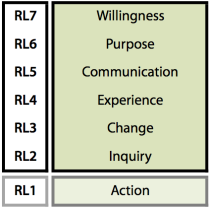
| Primal Need | Psychosocial Pressure | Varieties of Sapience | ||
| RL7 | Willingness | Effectiveness | Selflessness | Know-how |
| RL6 | Purpose | Governance | Autonomy | Moral judgements |
| RL5 | Communication | Association | Understanding | Meaningfulness |
| RL4 | Experience | Individuality | Well-Being | Self-awareness |
| RL3 | Change | Fitness | Acceptability | Discrimination |
| RL2 | Inquiry | Knowledge | Certainty | Knowing for sure. |
| Choose from the 6 knowing orientations on offer: | ||||
| RL1 | Action | Achievement | Performance | Using knowledge |
|---|---|---|---|---|
Dichotomy Conjecture:
Mentality v Functionality i.e. mental states v doing
also:
Mind v Machine i.e. information and pattern v physical mechanism
Consciousness v Behaviour i.e. mysterious mind v sensori-motor output
Responsibility v Instrumentality i.e. judgement v activity
Independence v Agency i.e. freedom to orient v capacity to act
This is the division emphasized by biologists, neuro-physiologists, hard data empiricists and behaviourists, most philosophers and many AI investigators. In practice, it is the approach that reduces man to a machine as in assembly-line work. More
More
5+2 Split: Rationality Dimension
The Representational Model of the Mind
Here the mind is viewed as an instrument for evaluating and representing a situation prior to any inquiry or action on it.
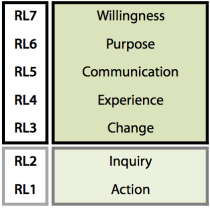
| Primal Need | Psychosocial Pressure |
Varieties of Modelling |
||
|---|---|---|---|---|
| RL7 | Willingness | Effectiveness | Selflessness | Working models |
| RL6 | Purpose | Governance | Autonomy | Systematized models |
| RL5 | Communication | Association | Understanding | Paradigmatic models |
| RL4 | Experience | Individuality | Well-Being | Internal models |
| RL3 | Change | Fitness | Acceptability | Persuasive models |
| Choose from the 5 models on offer: | ||||
| RL2 | Inquiry | Knowledge | Certainty | Using a preferred model. |
| RL1 | Action | Achievement | Performance | |
Dichotomy Conjecture:
Reflection v Execution
This is the division emphasized by planners, therapists, social architects and others who reject the simplicity of data or brute facts.
4+3 Split: Dynamic Dimension
The Evolutionary Model of the Mind
Here the mind is viewed as an instrument of personal growth that must accept that basic functions must persist.
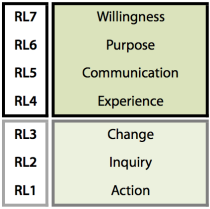
| Primal Need | Psychosocial Pressure |
Varieties of Development |
||
|---|---|---|---|---|
| RL7 | Willingness | Effectiveness | Selflessness | Spiritual development |
| RL6 | Purpose | Governance | Autonomy | Ethical development |
| RL5 | Communication | Association | Understanding | Social development |
| RL4 | Experience | Individuality | Well-Being | Egotistic development |
| Choose from 4 evolutionary possibilities on offer: | ||||
| RL3 | Change | Fitness | Acceptability | Focus on safety from danger. |
| RL2 | Inquiry | Knowledge | Certainty | |
| RL1 | Action | Achievement | Performance | |
Dichotomy Conjecture:
Thriving v Surviving i.e. developing the self v continuing existence
also:
Significance v Safety i.e. developing meaning v surviving
Subjectivity v Objectivity i.e. personal controls v situational demands
Development v Preservation i.e. drive to grow v drive to maintain
Flourishing v Functioning i.e. enriching focus v situational fitness
Humanistic psychologists focused on growth needs, self-actualization and transcendent values like this division. Gordon in integrative Neuroscience writes: The brain's overarching principle is to classify the world around you into things that either hurt you or help you stay alive i.e. it deals with safety.
Positive psychologists, sociologists, mentors promote significance, while Darwinian biologists and cognitive behaviorists take evolution for granted.
3+4 Split: Organisational Dimension
The Social Model of the Mind
Here the mind is viewed as a product of social life and individuals have to fit into various groups.
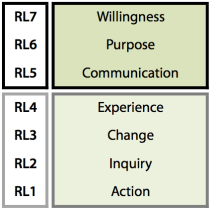
| Primal Need | Psychosocial Pressure |
Varieties of Group |
||
|---|---|---|---|---|
| RL7 | Willingness | Effectiveness | Selflessness | Humanity |
| RL6 | Purpose | Governance | Autonomy | Structured Group |
| RL5 | Communication | Association | Understanding | Informal Network |
| Choose from the 3 groups on offer: | ||||
| RL4 | Experience | Individuality | Well-Being | Individuals constituting a group |
| RL3 | Change | Fitness | Acceptability | |
| RL2 | Inquiry | Knowledge | Certainty | |
| RL1 | Action | Achievement | Performance | |
Dichotomy Conjecture:
Group v Individual
also:
Transcendence v Actualisation: Submission of self v Assertion of self.
Aspiration v Implementation:
Ideality v Reality:
This is the Trinitarian model of reality in which is the source of all energy, gives form to that energy, and sets forms in motion. An infinite variety of things can then be created using .
Legislators, political scientists, ethicists, humanitarians and sociologists focus on the upper section and assume personal functioning in the lower section must be shaped, managed or controlled for the good of all.
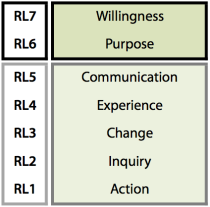
2+5 Split: Reality Dimension
The Control Model of the Mind
Here the mind is viewed as existing to modify reality.
| Primal Need | Psychosocial Pressure |
Varieties of Reality |
||
|---|---|---|---|---|
| RL7 | Willingness | Effectiveness | Selflessness | Control over reality |
| RL6 | Purpose | Governance | Autonomy | |
| Select from the 5 approaches to reality on offer: | ||||
| RL5 | Communication | Association | Understanding | Conformist |
| RL4 | Experience | Individuality | Well-being | Subjectivist |
| RL3 | Change | Fitness | Acceptability | Perspectivist |
| RL2 | Inquiry | Knowledge | Certainty | Speculative |
| RL1 | Action | Achievement | Performance | Practical |
Dichotomy Conjecture:
Energy v Existence i.e. the vitalizing forces v the stuff of life
also:
Direction v Participation i.e. why anything happens v how anything happens
Potentials v Actuals i.e. hopes for endeavour v phenomena of endeavour
The upper section is preoccupied with control over reality, while the lower section is where reality is defined and truth is determined, differently in each level.
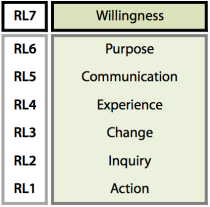
1+6 Split: Power Dimension
The Enlightenment Model of the Mind
Here the mind is viewed as entangled with existence such that self and other cannot be separated out.
| Primal Need | Psychosocial Pressure |
Varieties of Entanglement |
||
|---|---|---|---|---|
| RL7 | Willingness | Effectiveness | Selflessness | Power to transcend limits and entanglements |
| Choose which of the 6 forms of entrapment to escape from: | ||||
| RL6 | Purpose | Governance |
Autonomy | Entangled by values and cultures |
| RL5 | Communication | Association | Understanding | Entangled by societies groups, and networks |
| RL4 | Experience | Individuality | Well-Being | Entangled inside oneself |
| RL3 | Change | Fitness | Acceptability | Entangled by models, paradigms mindsets. |
| RL2 | Inquiry | Knowing | Certainty | Entangled by existing knowledge |
| RL1 | Action | Achievement | Performance | Entangled by courses of action |
Dichotomy Conjecture:
Spirit v The World
also:
Freedom v Obligation
This division is emphasized by existentialists, spiritual leaders, libertarians, heroes advocating the upper division, while the man in the street and bureaucrats remain in the lower division.
Summary of Splits
In these splits, the "mind" is allocated to the upper section, which means it is viewed very differently according to the model in use.
| Split | Model of the Mind | Emphasized Dimension |
Revealed Phenomena Upper v Lower |
|---|---|---|---|
| 6+1 (between L2 & L1) | Computational | Sapience | Mentality v Functionality |
| 5+2 (between L3 & L2) | Representational | Rationality | Reflection v Execution |
| 4+3 (between L4 & L3) | Evolutionary | Dynamics | Thriving v Surviving |
| 3+4 (between L5 & L4) | Social | Organisation | Group v Individual |
| 2+5 (between L6 & L5) | Control | Reality | Energy v Existence |
| 1+6 (between L7 & L6) | Enlightenment | Power | Spirit v The World |
Originally posted: 30 Nov 2013. Updated 6-May-2026.