Distinguish Communicative Elements
Step-3: Discover the Centres &
Step-4: Determine their Names
We now clarify whether the dynamic duality conventional vs new exists as opposite poles within a level, or whether the duality is intrinsically synthesized or fused (called 'balanced') within the level. Clarification generates «Centres» which need THEE-Names. You can see the pattern without names now by clicking  here.
We have to examine all 7 levels. Because we can take them in any order, I usually take the easiest first. All proposed names are provisional.
L5: Terms : Naming
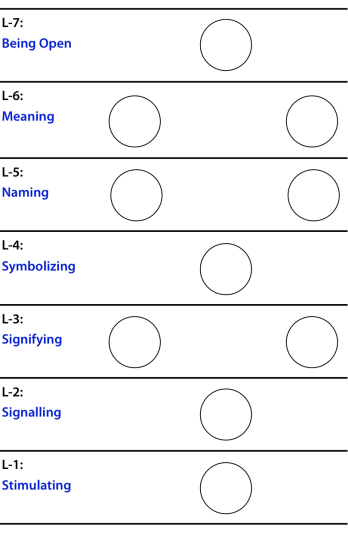
Naming evidently contains two polar opposite Centres.
Why?
Terms can be part of standard usage and everyday language. We help conversations flow by using these familiar ordinary and easily recognizable terms.
However, we can also invent terms (sometimes called «neologisms» from «neo» = new, «logos» = word). We may also deliberately choose rather unusual, quirky or idiosyncratic terms to suit our own particular purposes.
We cannot label an isolated term as in one pole or the other in the abstract or in any absolute sense. Our Tree reflects communication which is dynamic and social. So it is a situational choice, and classifying a specific term as common or unconventional will be a matter for those involved in a particular situation within a society and culture. This applies to every other level as well.
Example:
Scientific and professional disciplines (like this THEE inquiry) develop their own terms, often referred to as jargon. The same jargon word will be orthodox usage amongst professionals (i.e. L5C), but strange and unfamiliar if used with outsiders (i.e. L5U). Sometimes jargon is used to impress or obfuscate—what do you think of this communication:
"While in the run-up to transitioning in this phase of right-sizing and redeployment, we still need to—at the end of the day—drill down and make sure that our mission-critical, goal-oriented core competencies are in alignment and on the same page as the most current best-practices paradigm. While we as a customer-centric long-tail company are still on the runway, we need to each firewall enough time to allow out-of-the-box thinking and strategize the low-hanging fruit in the marketplace. Envisioning the metrics here will require accountability management on each team member to come up with a value-added solution that doesn’t require putting out fires or a lot of bandwidth. Bottom line? The truth is we have to step up, work smarter, not harder, and create a Web 2.0 solution. This is an exciting moment to transit to a future of innovation."
These two Centres are named:
Unfamiliar terms-L5U & Conventional names-L5C.
L7: Openness : Being Open
Being Open contains one balanced Centre.
Why?
To be open is to be accepting of any words or ideas (i.e. as named) or meanings, and to be ready to welcome and reflect on signs or symbols of all sorts: customary or anomalous, mainstream or individualist, received or invented, personally relevant or alien. So openness cannot split into two poles.
This single balanced Centre is named: Openness-L7B.
L2: Signals : Signalling
Signalling contains one balanced Centre.
Why?
Any signal must be unambiguous, that is to say recognized and understood immediately. Because a signal is explicit, there is no room for any polarity. A social group may agree to create an unusual and innovative signal, perhaps for privacy or to deceive others. But then everybody involved has to learn it if it is going to be of any use. That means the invented and apparently new immediately becomes the established and expected as soon as the meaning content is agreed.
This single balanced Centre is named: Explicit Content-L2B.
L6: Meaning : Meaning
Meaning contains two polar opposite Centres.
Why?
Meaning is generated and attributed during communications. Some meanings are strictly and unequivocally conventional, traditional, mainstream, expected and orthodox. Meanings can be sent as such or received and construed as such.
However, a meaning may be idiosyncratic or novel or unorthodox or imaginative. Sometimes a study or activity requires new meanings. Sometimes they are created (within the sender or the recipient) to be surprising or disturbing. A meaning may also be perceived or construed in a novel and unexpected way: this is a feature of psychodynamic interpretation.
These two Centres are named:
New meaning-L6U & Usual meaning-L6C
L4: Symbols : Symbolizing
Symbolizing contains one balanced Centre.
Why?
Symbols make a connection between otherwise wholly unrelated things and open the door to the widest variety of potential meanings. The various ramifications of the symbol will be in line with cultural-linguistic traditions generally and within the specifically relevant group. The connections must be automatic and seem natural. Could poetry be different: a special case? No, because if a symbol does not fit within a group's experience and convention, then it is impossible to understand it. In other words, the genuinely and fully unconventional symbol can be neither created nor understood. Because it fails to communicate from a sender's or a receiver's perspective, it is not a symbol at all.
This single balanced Centre is named: Symbolic Connotations-L4B.
L3: Signs : Signifying
Signifying contains two polar opposite Centres.
Why?
Signs require the application of knowledge and experience to something within a delimited area. In deciding significance (i.e of a stimulus or phenomenon regarded as a sign), it is possible to do so in a standard, mainstream and orthodox way. Often the sender or recipient will lay claim to being objective. To render meaning, he/she will identify features or clues said to be predictive or indicative on the basis of established knowledge.
However, it is also possible to draw significance quite differently and in a more personal and inherently unpredictable way. Such individualistic subjective significance may well seem skewed, irregular, or surprising.
These two Centres are named:
Subjective significance-L3U & Informed significance-L3C.
L1: Stimuli : Stimulating
Stimulating contains one balanced Centre.
Why?
Everyone differentiates between stimuli that are part of a communicative event, and those that are ambient noise and cause irrelevant sensations. To be part of a communicative event, stimuli must accord with prevailing custom and expectations. However, at the same time, every stimulus is different and will be generated or experienced in accord with a person's physical, emotional and social state.
This single balanced Centre is named: Communicative Stimuli-L1B.
Step 5: Identify Dominating Centres
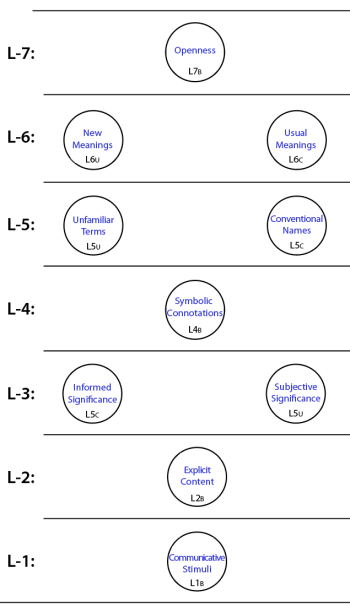
Having clarified the Centres, we have to determine dominance in those levels which are bipolar: Meaning-L6, Naming-L5, Signifying-L3. Which pole has more weight when communicating in a particular situation?
L6-Meaning
Is the usual meaning most readily accepted or is a new meaning? Which of these carries the day in a discussion or argument?
Drawing on my experience with discriminating differences in social life and developing explicit but somewhat unusual meanings-L6 that require their own specific names-L5, I can confidently assert that the usual meaning normally trumps. More...
It is often an effort to get someone to put their way of making sense-L6 to one side, and consider a different meaning-L6. THEE-names-L5U are all conventional terms-L5C used with an unconventionally precise reference, i.e. meaning-L6U, which is not too distant from its usual meaning-L6C.
L5-Names
Is an invented name-L5U (e.g. a neologism or an atypical term) more readily accepted and understood than a conventional term-L5C? Or vice versa? Which do we default to?
This one is easy: conventional terms-L5C are far more appealing. By contrast, invented or obscure terms-L5U, especially technical jargon, seem clumsy, ugly or even repellent. Journalists, for example, use scientific concepts loosely in order to make their prose easy to read.
Example
One of the 7 methods for using language is distinguished by its use of formulae. I wanted to name the method “formulaic”, partly because the word sounds like «formula». However this disturbed people because "formulaic" has come to mean-L6C mediocre, routine, unimaginative or ‘imitative. I did not believe it was possible to shift this usualmeaning. Formal was the next option, but that is name of a type of inquiry (PH2L'6). so I chose «logical» as the THEE-name which is both familiar and meaningful.
L3-Significance
Does subjective significance-L3U take precedence over informed significance-L3C? Or is it the reverse?
Informed significance-L3C requires us to accord with official, standard or objective knowledge, whereas subjective significance-L3U is about bringing to bear our own sense of a situation. This depends on our experience and our knowledge, as well as using any conventional knowledge that we might be aware of. We may listen to experts and absorb a lot, but we invariably give our own interpretations and understandings precedence. So subjective significance L3U dominates—also because it is what we have to depend upon when experts aren't available.
Next Step 6
Now that all Centres are named and dominance is determined in the bipolar levels, it is necessary to clarify mutual influences between the Centres.
THEE Note: This is the lengthiest and most difficult part of Tree development: Step 6 in the standard method. The first channels to be identified are those joining the two poles in a bipolar level.
Originally posted: 8-Nov-2013. Last updated: 14-Mar-2016.