Stabilizing Communicative Exchanges
Once the intrinsic tension (dynamic duality) is applied to communicative elements, Centres form that can affect each other. In looking at these influences, the splitting of three Levels: , and demands attention. If there are disjunctions here, a communicative event will go astray. Each pole requires input from the other to .
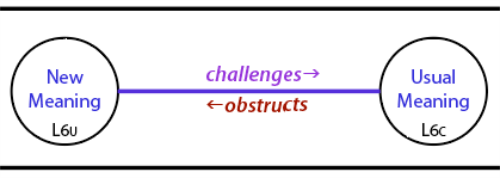
L6: Meanings—New or Usual
As are about making sense of reality, any unfamiliar, original or unorthodox will be experienced as a challenge to the usual standard , sometimes an extremely forceful one.
Of course some struggle or die out because have considerable potency: e.g. the of 'sign' or 'symbol' may actively obstruct website visitors from grasping the offered here.
A person who starts addressing a group of friends by saying "first let us define a few terms" sets them a tough task. He has usually taken ordinary words and loaded them with something new. The obstructive effect in the listeners’ minds of the may make constructive participation in the discussion rather difficult for them.
Although this website does not define concepts, some may have a similar reaction to the two meanings of , the conventional and the unusual, that has beem introduced here. However, a cannot block a for those who find it necessary. It is the task of this framework to demonstrate this necessity

L5: Terms—Conventional or Invented
Standard or and new or affect each other. Dictionaries of etymology (in the case of verbal terms) explain how and when a originated. The implication is clear: existing common terms were new at some time in the past.
Many disappear while others persist and soon become as the norm. Sometimes a replaces the in an attempt to inject life. The standard may slowly become obsolete, fall from use and be viewed as archaic.
It is noticeable that many things or processes have a wide range of applicable names (i.e. synonyms), often with minimal or rather subtle shades of differences in their reference.
A benign tolerant influence seems to apply. must accept or tolerate when communication demands this. In general, people seem to prefer those terms with which they are . The exception is where the parallels an invented object or activity of interest to them, and there is no .
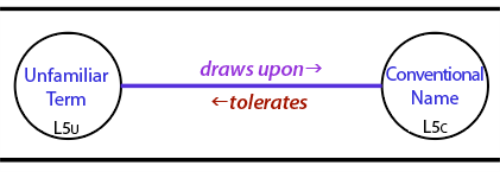
draw upon those that are . , for example, often take bits of known terms relevant to the topic and push them together (e.g. psycholinguistics); or they put a conventional prefix or suffix onto an existing term (e.g. neocons). Sometimes work because they intentionally echo an existing term e.g. podcast derives from broadcast, webinar derives from seminar.
In an acronym, the first letters of a series of words make a word that may never have existed before perhaps because the entity is new e.g. 'radar' was generated by the invention of "radio detection and ranging". 'Laser' has a similar origin.
Not all are neologisms: e.g. businesses must give new names to new products; and every new company has to have its own distinctive name. We can usually see an effort to draw upon what exists: a business is named after the town, or the suburb, or the founder, or its main category of product. Parents-to-be buy books of existing children's names, or name children after an older relative or current celebrity, or a desired virtue or favourite flower.
L3: Significance—Informed or Subjective
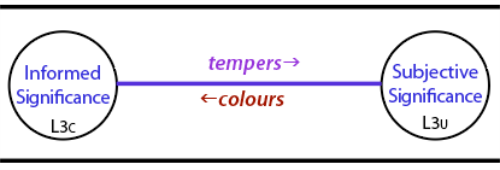
Situations benefit from a calm dispassionate view. However, our of events may push to extremes, diminishing or intensifying, beyond what is reasonable. I may view a bodily symptom either too nonchalantly or far more anxiously than is warranted. A doctor's can and should temper my personal view.
Nevertheless the that I attribute affects the doctor's view and what he says to me. While not altering the view, it is likely to colour it.
The view of someone who is abrupt, impolite and glares may be that these are of anger. However, a assessment might suggests they are signs of embarrassment over an error. The subjective significance colours the conventional interpretation.
-
The following steps that are about maintaining the flow and sense of a communication by linking Centres that cross levels have only been provisionally developed.
The current tentative account is provided in the Taxonomy Notes. Revision and posting in this Satellite will be arranged in due course.
Originally posted: 8-Nov-2013. Last updated: 16-Oct-2026.
