Review: Determinants of Fitting In
Fitness as a Primal Need
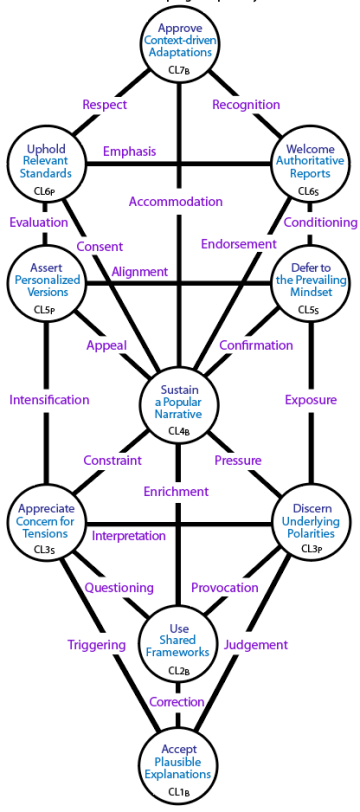
Fitting in highlights the individual's need for groups, and brings into sharp focus the dynamic duality of personal v social found in every Tree pattern. No functioning of any sort can take place without some influence from the socio-physical milieu.
Fitness can be a survival issue. For those who feel they do not and cannot fit in, managing communications and self-control over actions may be socially protective. Vagueness and ambiguity may be used to this end. The problem is that while others may accept those who look the part and cause no upset, their inner need for fitness is not being met i.e. there is no personal protection. Such a situation is intolerable: it damages self-esteem and leads to depression and suicidal ideation.
Example:  Goth Subculture
What was not clear or insufficiently emphasized prior to this investigation is the way that fitting in is channeled through and . These functions are naturally dependent on the and it is notable that the method in general use in society is . Universal language does not demand precision or conviction, but merely consensus with an implicit feeling that mutual understanding is occurring regardless of whether this is the case.
Differences in Values
In thinking of fitting in, the effect of differences in value systems, ideologies and conventions requires attention. These all belong in the , specifically: , and relate to living in general and the need for coexistence: see Ch.4 and Ch.9 in Working with Values. Within any particular group, differences in values can be irrelevant if the purpose of the group and its shared reality are respected by all members.
A bigoted or segregationist approach within a group can be exclusionary, but the issue of fitting in does not exist in such cases. You cannot fit in where you are told that you do not belong.
A person may be rejected from a group for rank incivility, rudeness or breaches of etiquette. If this is accidental, then an apology usually suffices. If it is deliberate then the individual is deliberately getting themselves rejected.
Fitness & Conformity
is used here to refer to an individual's capacity to belong to an enduring social group by genuinely sharing the reality of the group. This may superficially manifest as conformity. However it is possible to conform without actually fitting in. So the two terms are not synonymous.
In THEE, is the name assigned to an ethical disposition to follow societal , and for identification with .
Because focuses on specific social rules, it becomes a basic requirement for any social order.
By contrast, focuses on the depiction of a group's current reality, and is a basic requirement for a person seeking to belong to that group,
In social science, conformity is viewed behaviourally as a matching of attitudes, beliefs and behaviours to a group norm. Conformist behaviour may be habitual and automatic or compliant and due to social pressure. The significance of social pressure was demonstrated in a series of classical experiments by Asch in the 1950's.Details
Both fitness and conformity are universal, even if collectivist cultures differ from individualist cultures. Conformity to rules and fitness to sustain belonging to chosen groups are identified in THEE as distinct fundamental functions of human beings.
The Pattern
The analysis proceeded using the standard Tree pattern. However, it is always wise to check that other direct Channels are not required and explain why.
Check Other Channels
Each Centre will be examined in turn starting from the top.
connects lower to and . It does not connect directly to because adaptation of an account to a context is irrelevant to a personal version or the popular mindset. Nor does it connect directly to , , or because these states require mediation.
connects lower to and . It does not connect directly to or lower because these states have to be mediated via the narrative and mindset. can directly influence , but not because that depends on mediation. Similarly can directly influence , but not because that requires mediation.
connects lower to and . It does not connect directly to because frameworks are too general and abstract. can directly influence , but not because that depends on the narrative. Similarly can directly influence , but not .
connects lower to and . It does not connect directly to because explanations need mediation.
connects lower to and .
► Recognize the internal duality and consider the effect on the Tree of becoming self-centred.
Originally posted: 1-May-2025. Last amended: 25-eb-2026.