Centres for Fitting In
To create the , clarification modes are first treated as levels, and then their essences are considered in terms of practical activities and group expectations. The activities in this case are about clarifying for yourself, offering or exposing an account of a situation, and conforming (or not) to your group's view of the situation.
In this process, the dynamic duality will come into play and we must determine whether the mode essence is primarily determined by personal factors, by group factors, or by a fusion of those two poles.
The analysis will proceed level by level starting from below.
Causal Foundation: CL1
Saying nothing, being satisfied by accepted by your group, and offering that are plausible appear to be fundamental to fitting in to your relevant group. Any explanation must be simultaneously plausible for you as well as being socially satisfactory. If the group explanation is referred to as “what they would say”, then the person is distancing themselves and is on the path to self-exclusion. Openly and regularly challenging explanations that the group finds plausible reveals a lack of fit.
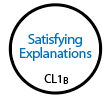
So, in the Tree, this level becomes a single balanced Centre: .
We will label :
Structural Control: CL2
are developed to be shared. Models of a situation must be useful and meaningful for both individual members and the group. Anyone who does not master or use or refer to a framework or model in the same way as those around them will clarify and conclude things differently to others. Arguments will develop and such individuals will not fit in. It seems that the two poles must be fused in practice.
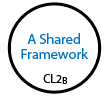
So, in the Tree, this level becomes a single balanced Centre: .
We will label :
Dualistic Tensions: CL3
exist in all situations based on divisions of interests and conflicting values of those involved. Strong disagreements and persistent disputes are concerning for all, become part of general conversation and may and appear in media reports. Individual members would not feel it necessary to dissent from observations of conflict, nor would acknowledging the presence of tensions be any sort of personal commitment to either side.
Individuals who have studied the history of tensions in this and related situations are likely to identify and emphasize an underlying polarization. While others may not wish to see that division or may not fully comprehend its intensity, such ignorance or disagreement would not prevent an individual affirming the polarization.
This means that this level in the Tree will generate two polarized but connected Centres: and .
We will label :
and label :
Tensions can erupt and recede as times change, while any underlying conceptual or ideological polarization is an enduring feature of the situation. So the Centre is dominant and placed on the right side of the Tree.
 The CL3 Linking Channel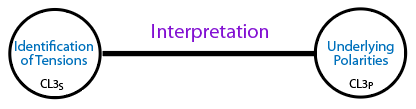
Dynamic Evolution: CL4
Based on an analysis of interactions and the historical evolution of the situation, one or more can be constructed. The aim is to create a sense of realism so as to shape the way people think, and that is why factions competing for support develop their own narrative. These narratives need to persist even as time passes and the situation evolves.
Each person wants to hold a narrative in mind that suits them, but to fit in they must choose from one of the available narratives. A unique personal narrative with its emergent scenarios cannot coexist in practice with a completely different narrative held by the group. That means narratives are recognized simultaneously by members and by the group as a whole.

So, in the Tree, this level becomes a single balanced Centre: .
We will label :
Atomistic Mind-Sets: CL5
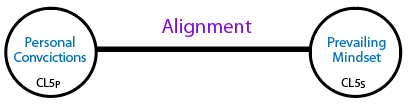
Every one responds to situations and any given narrative in terms of their current way of thinking, which can be called an outlook or mind-set. Mind-sets are characteristic of both individuals and groups: so there are two types of ownership.
For an individual, assimilation of the narrative leads to a personalized version of any situation and the group is not involved directly here. However, any group, community or wider society, has ways of thinking about things that are generally recognized. Popular mindsets affect interpretations of relevant events and everyone needs to be aware of the current outlook as a matter of tact and good manners.
This means that this level in the Tree will generate two polarized but connected Centres: and .
We will label :
and label :
The prevailing mindset, being more predictable, enduring and general, unites people and can shape or even over-shadow any person's particular version. So the Centre is dominant and placed on the right side of the Tree
Unitary Standards: CL6
Groups want any form of clarification to conform to well-established and systematically applied standards of evidence, reasoning and other commonly agreed rules or principles. Otherwise the explanation will be doubted and even deemed invalid. Versions of the situation that have been developed and revised in these terms become authoritative for the group and its members.
Individual members, independently of the group, can determine which standards are relevant and apply these to any accounts that are generated, even authoritative reports.
This means that this level in the Tree will generate two polarized but connected Centres: and .
We will label :
and label :
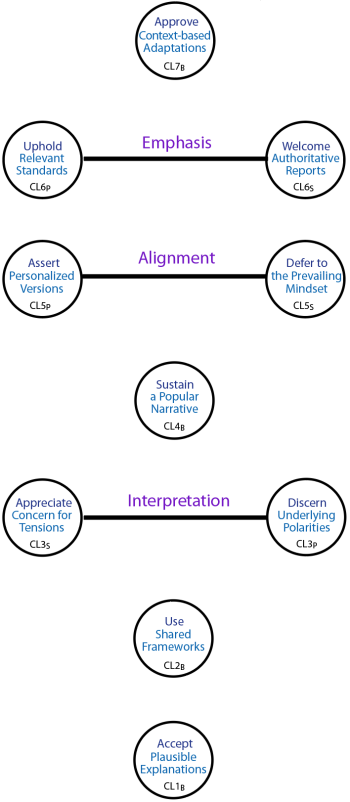
Authoritative reports by the group are more influential than particular members who may idiosyncratically choose to uphold specific standards. So the Centre is dominant and placed on the right side of the Tree.
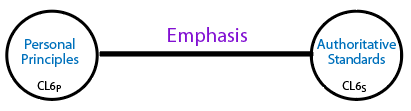
Any community and every member is aware of and assigns great value to socio-cultural axiomatic standards for appraising and accepting explanations. At the same time, and quite separately, each person is likely to possess and identify with principles that will be used to judge any explanation or narrative.
People are expected to uphold their own principles because these cannot be alien to the communal standards. The development and application of personal principles will be influenced by socio-cultural paradigms, and will have emerged in part from them. Each Centre emphasizes the importance of the other.
Unified Adaptation: CL7
Context-based adjustments are made when any account is applied. The group as a whole has to accept the adjustments. Each person in the group must be confident about that adjustment in order to belong and participate in activities.
While a person on their own might well make changes to an account to fit their particular context, this is simply a group of one. In other words, there cannot be both a specific individual adjustment and a different group adjustment for the same context because this would generate confusion and conflict in activities.
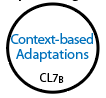
So, in the Tree, this level becomes a single balanced Centre: .
We will label :
-------------------------------------------------------------------------------------------
Having identified the 10 Centres in the 7 levels and the integration of the bipolar Centres at L3, L5 and L6 (as shown at right), the next step is to specify channels of influence between the Centres.
There are several ways to proceed. For this investigation, the focus will commence with:
► Channels to and from the two Centres that appear to be at the heart of any social consensus and demand for conformity.
All channels feeding into a
All channels feeding into the
► Then, the two peripheral channels, left-sided and right sided, moving from at the top down to at the bottom.
► Finally the inappropriateness of additional direct links are checked here.
Alternatively: Jump ahead and see the completed Tree with all channels named.
Originally posted: 10-May-2025. Last amended: 25-Feb-2026.