Two Key Centres
Two Centres appear to serve as a focus for fitting in: acceptance of a Shared Framework (CL2B) and acceptance of a Popular Narrative (CL4B).
Influences around Shared Frameworks (CL2B)
To & From Plausible Explanations (CL1B)
 Detail
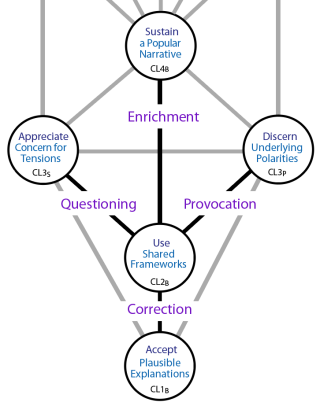
Existing explanations cannot be ignored in using a shared framework without potentially humiliating those adhering to them. At the same time, any shared framework cannot be ignored in developing even superficial explanations without appearing to be ignorant. So a channel of influence must be present.
The two Centres draw on very different processes: the CL2-framework is systematic and comprehensive: which suggests it needs to include factors relevant to plausible explanations. Explanations may well indicate what needs to be modelled and where structure is missing.
The CL1-explanation is focused on plausibility, which is enhanced if it draws on aspects of a widely shared framework. The framework can help explanations be more coherent, consistent and grounded. In this way it provides for a more formal plausibility.
So there is a channel affecting fitting in:
CL2B ↔ CL1B is provisionally labeled Correction
To & From Underlying Polarities (CL3P)
Detail
CL3P-underlying polarities is about deep, often implicit, opposing forces in the situation. The CL2B framework by contrast is a simplified public schema which typically omits cultural, ideological and emotional factors intrinsic to polarization.
Polarization therefore provocatively introduces elements that the framework is ill-equipped to handle. Conversely, the framework will itself provoke those preoccupied with social conflicts generally to reveal how these polarities apply in the situation.
So there is a channel affecting fitting in:
CL2B ↔ CL3P is provisionally labeled Provocation
To & From Concern for Tensions (CL3S)
Detail
CL3S-concerns for tensions are pressing and immediate while the CL2B-shared framework is an abstraction that endures. Tensions are universal and frameworks must allow for them. However, there will be a question of how relevant the tensions are to the framework's depiction.
When tensions are identified as a matter for concern, they can question the sufficiency or even coherence of the existing shared framework.
So there is a channel affecting fitting in:
CL2B ↔ CL3S is provisionally labeled Questioning
To & From a Popular Narrative (CL4B)
Detail
The CL2B-framework and the CL4B-narrative are similar in that both are offered as coherent and comprehensive models. However, the framework is static in nature and commonly general across a variety of situations within a category, while the narrative is dynamic, evolutionary and specific to a particular situation.
The framework gives structure and analytic power to the narrative and indicates its scope, while the narrative provides actual content for the framework's abstractions, generating depth and life.
So there is a channel affecting fitting in:
CL2B ↔ CL4B is provisionally labeled Enrichment
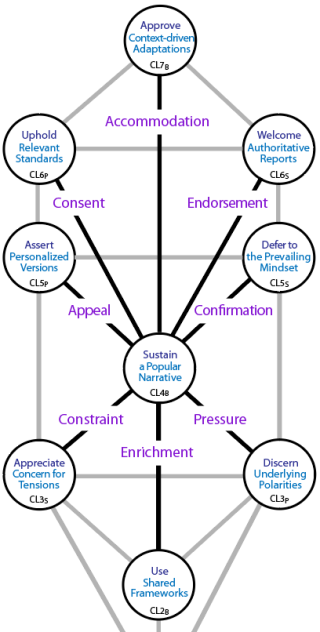
Influences around the Dominant Narrative (CL4B)
To & From Context-driven Adaptations (CL7B)
Detail
The CL4B-narrative remains the primary account of the reality of the situation, especially if supported by other Centres. There must be a narrative core that remains intact and viable even while it accommodates adjustments that flow from differences in context.
Context can have a powerful effect on how matters are viewed and what is done, but CL7B-contextual adaptations have strict limits. They must accommodate the given narrative while ensuring that it remains usable in the particular setting.
So there is a channel affecting fitting in:
CL4B ↔ CL7B is provisionally labeled Accommodation
To & From Authoritative Reports (CL6S)
Detail
Credible CL4B-narratives will accord with CL6S-authoritative reports. That means broadly conforming to their contents, appealing to them, and generally endorsing their significance.
In turn, such reports will be used to judge a narrative and may constrain or modify it to ensure it is legitimate and deserves to be sustained. Any accepted narrative will therefore be expected to be endorsed by authoritative reporting.
So there is a channel affecting fitting in:
CL4B ↔ CL6S is provisionally labeled Endorsement
To & From Relevant Standards (CL6P)
Detail
CL6P-relevant standards enable a person to judge, value and ultimately accept, qualify or reject any given CL4B-narrative. Relevant personally-owned standards therefore determine psychological consent to the narrative.
Conversely, popular narratives must consent to the application of a diverse variety of principles from many individuals.
So there is a channel affecting fitting in:
CL4B ↔ CL6P is provisionally labeled Consent
To & From the Prevailing Mindset (CL5S)
Detail
The CL5S-prevailing mindset is a rather generalized outlook on the situation and it needs to confirm that any CL4B-popular narrative is credible and realistic.
The accepted narrative is a more complicated account of the situation and its evolution. It will be most readily accepted if it is in accord with and confirms the validity of the popular way of thinking about such situations.
So there is a channel affecting fitting in:
L4B ↔ L5S is provisionally labeled Confirmation
To & From Personalized Versions (CL5P)
Detail
CL5P-versions are based on simplifying and re-wording a CL4B-narrative to suit the person's understanding. So a person will always appeal to the narrative to justify and confirm their version.
Similarly, when an individual sustains a popular narrative, they will draw on and appeal to their version of the situation.
So there is a channel affecting fitting in:
CL4B ↔ CL5P is provisionally labeled Appeal
To & From Underlying Polarities (CL3P)
Detail
CL3P-polarities are socially disturbing and often pushed out of public consciousness. Those individuals aware of polarization and its importance therefore put pressure on any CL4B-narrative to incorporate and explain their role in the evolution of the situation.
In order for the CL4B-narrative to be popularly accepted, pressure can be placed on members to keep polarities hidden, softened or re-framed. Individuals who recognize the importance of the polarity are likely to push back against such handling.
So there is a channel affecting fitting in:
CL4B ↔ CL3P is provisionally labeled Pressure
To & From Concern for Tensions (CL3S)
Detail
CL3S-tensions refer to disputes and social conflicts that are difficult or even impossible to ignore. So a CL3S-narrative will not be persuasive if it does not somehow incorporate them. The narrative is therefore constrained to provide a frame for clarifying their nature, impact, and evolution over time.
However, tensions also constrain the narrative which should be articulated in a way that does not exacerbate tensions in the situation or inflame any of the participants.
So there is a channel affecting fitting in:
CL4B ↔ CL3S is provisionally labeled Constraint
To & From Shared Frameworks (CL2B)
Detail
This channel was examined above.
So there is a channel affecting fitting in:
CL4B ↔ CL2B is provisionally labeled Enrichment
To & From Plausible Explanations (CL1B)
Detail
Narratives can coexist with a wide variety of explanations of particular situations and any influence is exerted by way of evident tensions and shared frameworks. Similarly, explanations cannot influence narratives without mediation by some framework or evident polarizing tensions.
There is no direct channel.
Originally posted: 10-May-2025. Last amended: 25-Feb-2026.