Approach to the Investigation
Names
The initial challenge is to:
► name the elements of Willingness
► formulate their functions, and
► order them correctly.
The process here is clarification (v. Change Domain), not simple observation (v. Inquiry Domain).
To penetrate the confusion that pervades this subject, we must avoid clumsy and potentially confusing formulations like "willingness to [X]", especially if X is an abstraction from everyday life. It is essential to realize that willingness in real life—like purpose, inquiry, and all other levels-of-will—appears in its own distinctive forms. Of course, each element will have its own unique intrinsic object, called if there is any doubt, the formal object.
Whatever elements are identified, they will be taxonomically unique and concrete with the implicit sense of willingness unmistakable—even if they can be tautologically formulated as "willingness to [the element]".  To restate with examples:
Using Taxonomic Principles
Studies in the Architecture Room revealed that each Root Level emanates a Primary Hierarchy; and the Levels in the Primary Hierarchy are formed by projection from the Root Hierarchy on a 1:1 basis. (Click thumbnail to see.) The projections are conjectured to be psychosocial pressures.
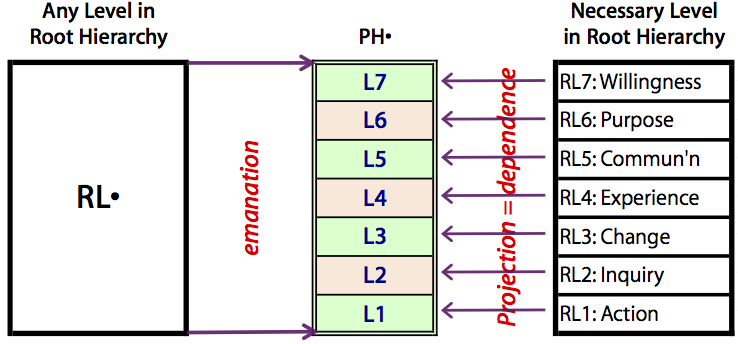
So PH•L1 depends on RL1, PH•L2 depends on RL2, PH•L3 depends on RL3, and so on.
That means emanates , and then:
The entity necessarily involves Action-RL1 and is subject to a psychosocial pressure for performance.
The entity necessarily involves Inquiry-RL2 and is subject to a psychosocial pressure for certainty.
Formulations
The name of each (i.e. element/level in the Primary Hierarchy-PH7) must refer to the way a person can and sometimes must function in psychosocial reality as an expression of being willing.
This function must be definitive, distinctive, and unambiguous. However, because these are universal experiences, there could well be suitable alternate names and (potentially confusing) synonyms.
The function that defines the element needs to be complemented by distinctive properties which help distinguish one kind/level of willingness from another. Properties relevant to this inquiry would include practical issues like:
•typical benefits of being willing,
•typical fears of being willing,
•manifestations of unwillingness,
•ways to handle unwillingness.
Finally, the hierarchical relationships of the various elements must be demonstrated. This is usually possible by discovering a natural cumulative development in practice (cf. inquiry; communication); and by identifying natural transitions upward and downward (cf. purpose).
Structural Corroboration
Having established the elements and their hierarchical structure, there are expected to be additional structural properties that illuminate and further clarify the nature of the forms of willingness. These include:
-
Odd- and even-levels revealing an oscillating duality (oD) that ensures a sharp demarcation of levels.
-
Existence of a Principal Typology (PH'7) in L6.
-
Application of a dynamic duality (kD) to form a Tree (PH7K) pattern.
-
Natural combinations of adjacent levels generating a structural hierarchy (PsH7).
-
Control structures developed from the Spiral (PH'7C).
Having clarified the way this inquiry will be pursued, you can check the expected architecture.
Originally posted: 3-May-2026. Amended: 27-Jun-2026.