Psychosocial Energy
The Concept of Energy
We speak of "high energy" people or teams with "low energy": but what does that mean? What is such energy in relation to a person?
In physical reality, energy is the capacity to do work and/or produce heat. But while the body is a physical object and requires that sort of energy, this has very little to do with the energy just identified.
In the social science literature, this energy is defined as vitality or vigour: but that is not a definition but a tautology. One term is replaced by another. This energy is often viewed as a "feeling", which is then characterized further by effects on activity: like resilience, persistence, power, determination, self-regulation.
The taxonomic conception of energy moves sharply away from inner feelings or mental states to an operational perspective:
Energy is the capacity to function in psychosocial reality.
Living requires continuing functioning, so it requires a flow of this energy.
The Source of Energy
The human will manifests as the root hierarchy that enables endeavour, which is the fundamental unit of functioning in psychosocial reality.
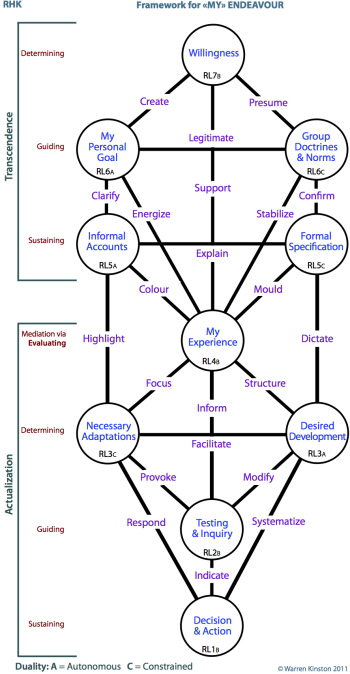
It is conjectured that the energy of the will (willpower) is manifested solely in , which is therefore the source of all energy and the reservoir of positivity. This energy is then available to flow down into the lower levels.
Cf. «Use willpower» as the initial requirement for creativity in endeavours and therefore the foundation of being creative.
Without the initial "Yes" of willingness, a person is inert. Without a continuing flow of positivity from willingness, no endeavour can be sustained. However, willingness only represents energy as a potential. To be enabled for functioning, explicit purpose (i.e. values, goals) must be present.
then represents energy available for use. This combination is what makes all the difference between activity that is perfunctory and activity that is personally meaningful, energetically pursued and likely to be socially significant.
So a "high energy" person is not just willing, but is committed to very clear values or goals. That energy is pumped into and becomes socially visible.
High energy is the psychosocial signature of an alignment of willingness and purpose, and perhaps there is a multiplier effect such that: L7 x L6 = kE.
But both Willingness and Purpose domains manifest in practice via their 7-level Primary Hierarchy Trees: specifies a , while specifies a . So in practice, a is liable to be communicated with high energy.
Note that there has been no mention of feelings. The framework of endeavour developed here and graphically represented at right explains this as follows: a channel links directly to , so willingness tends to create positive emotional states as a support for itself. The converse is true as well: relevant experiences will impact on willingness and support it.
Psychosocial Pressures
The psychosocial pressures are instinctual forces based in our neurobiology that are always in play. With awareness, they can be managed. The combination of Willingness-RL7 and Purpose-RL6 can be usefully viewed in these terms.
The pressures that are of concern here are selflessness at RL7, and autonomy at RL6.
Selflessness is the pressure to put one's ego and self-interest to one side and participate in a whole that is beyond oneself.
Autonomy is the pressure for self-assertion and self-creation, for the freedom to be the source of one's own actions and values.
These two pressures naturally interact to maximize effectiveness in functioning i.e. ideally Autonomy-RL6 should manifest through Selflessness-RL7. Energy is therefore the result of an autonomous identification with a selfless commitment.
Selflessness without Autonomy results in passive compliance with low energy.
Autonomy without Selflessness represents a refusal to yield to the endeavour (as apart from the self) and so energy is poorly channelled and gets dissipated.
"Low energy" individuals are withholding willingness from a specific goal and for some reason they resist being involved. Talking them into it may work, but it does not overcome failures in the willingness domain (e.g. low trust-L7, risk-aversion-L5, not seeing the reality-L3, contrary beliefs-L2). Nor does it create identification with associated values due to personal disagreement, or to ambiguity or confusion, or conflicts of interest. Without positive identification with key values, there will be a weakening of autonomy pressure and an inhibition of selflessness pressure.
Everyone enjoys discharging their selflessness by submitting to goals of their own choice: their autonomy authorizes their selfless submission.
Example: the framework for structuring organizations adheres to this principle. It maximizes staff autonomy by ensuring that (a) management provides the context, and (b) roles are defined by responsibilities that allow for discretion that fits personal capability.
Negative Energy?
The current proposition is that the Willingness domain contains or represents unalloyed . Positivity is therefore not simply a reaction or an interpretation of circumstances or a trait of personality, but something far more fundamental.
As noted above, zero energy is incompatible with living and therefore impossible by definition. So negative energy must also be impossible.
However, negativity can impact on willingness and reduce available energy. For example, there are undoubtedly negative emotions and ideas, and they influence willingness via the as explained above.
Similarly, are inherently bipolar because a value can be either positive (good) or negative (bad). There are two channels, and negative, destructive or inhibitory values can reduce willingness.
A person can only be "totally unwilling" in relating to a specific delimited challenge. In such a case, either the situation is not invested with relevant personal experiences, or existing negative values and goals are blocking involvement.
It seems that a person with high Willingness but no Purpose would be restless and ineffective, while a person with clear Purpose but little Willingness could be principled but inert and ineffective.
 Implications for Motivation
It is not possible to add energy to a person. Subject to good physical health and no serious distractions draining energy, all that can be done is to foster identification with relevant values and goals and the release of willingness for a target. That is often referred to as providing "motivation".
Leaders do use value-based motivations:
• using inspiration (ultimate values-L7)
• activating obligation (value systems-L6)
• focusing on needs (social values-L5)
• appealing to interests (principal objects-L4).
Management is preoccupied with strategic objectives and strategies, tactical objectives and tasks. So that is where motivation is focused. Many motivational efforts in management are fundamentally flawed because their focus is on forcing Action-RL1. Without links to energy fundamentals, this can easily lead to resentment or burn-out.
Incentives are relevant to staff in organizations and researchers have divided these into genuine motivators which are all about doing the job, and hygiene factors which ensure a basic satisfaction. Hygiene is where salary, status, security and similar items belong: they are not motivators. The proper motivators include: •doing the work, •achieving, •being recognized, •carrying responsibility and •advancement—all of which are forms of functioning and tap into willingness one way or another. The popularity of carrot-and-stick methods can be traced to the mentality of power-centred employees.
Management expects employees to be motivated based on obligation (see above) and to muster perseverance as they tackle challenging tasks creatively. Motivation in creative effort entails using all levels except willingness and purpose: if those levels are included, perseverance shifts into a higher gear generating justification and ultimately determination.
The have been formulated in terms of energy and momentum. See especially directed motivation.
Now that the orientation is complete:
- Remind yourself of the taxonomic path.
- Investigate the elements of willingness.
Originally posted: 3-May-2026. Amended 4-Jun-2026.