Two Forms of Stabilization
Mental Stabilization and the Self
provide for life stabilization. Your primal quest, when identified and this may take many years or even decades, provides an inner confidence that your life is on the correct course.
Circumstances may block Quest pursuit somewhat, and then there will be a degree of frustration and irritation. However, while can be blocked if you are having a hard time, the other Quests seem to be able to find an outlet in most circumstances. It can usually be anticipated that a time will come, possibly years ahead, when the Quest can be more wholeheartedly followed.
We are mostly concerned to be mentally stabilized on a day-to-day basis. We are aware that we must simultaneously manage our many trivial demands and serious tasks in a balanced coherent way. Quests provide the context for this everyday functioning.
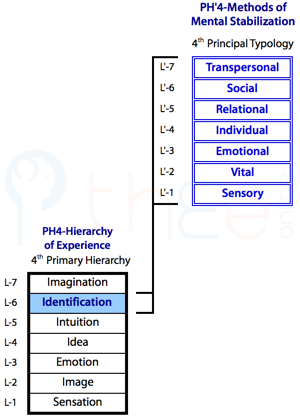
Everyday functioning depends primarily on the continuing integrity of the self. Loss of integrity generates an intensely distressing feeling of being overwhelmed.
The methods of (see graphic at right) provide alternative way to ensure that the self can function properly. These methods are also the basis for identity development and generate psychotherapeutic methods.
There is much less mystery here. In early adulthood, most people recognize their dependence on keeping fit, or emotional sharing, or group participation, and so on. As usual, our identification with a particular Principal Typology method is not easily explained. Certainly methods are not simple conscious choices.
We notice that if our method is blocked for any reason, we do not feel right. Quickly, often within a week, we start becoming miserable or depressed, anxious and unhappy. Focus and concentration start weakening and work becomes difficult. Restoration of our chosen method typically reverses these states with minimal delay.
Differences between the two frameworks are summarized in this Table:
| Primal Quests (RH') |
Methods of Mental Stabilization | |
|---|---|---|
| THEE Form | Root Typology | Principal Typology |
| Application | To endeavour selection: and may become relatively inactive. | To the pursuit of endeavours: always active. |
| Orientation | To your life. | To your self—which is responsible for organising your life. |
| Function | To provide a purpose in life that brings happiness and meaning. | Maintaining smoothe effective functioning in everyday life. |
| Time-Scale | Months-Years | Days-weeks |
| Benefit | Life-centric: About the purpose of your life: getting life right and being happy. | Egocentric: about feeling "normal" and being able to cope with daily stresses. |
Spirituality and Transpersonal Being
There is no correlation or obvious correspondence between the these two frameworks for stabilization, even if some links can be developed. For example, might seem to lend itself to the . Empirical research is required to check this hypothesis.
There is one area of potential confusion suggesting that even a superficially obvious correspondence is not a necessary connexion in practice: and that is and .
is stabilized by faith and demands a personal commitment to open oneself to union with humanity and the Cosmos. If a person finds themselves requiring transpersonal methods to be themselves and function on a daily basis, they can easily present themselves to the world as spiritual and enlightened. However, their true colours will be determined by their Quest. If they are on a and are not fleeing there due to inner damage, then all should be well.
If however, a spiritual guru is on a , then their transpersonal self can very easily be used to obtain pleasure while professing to be uniting with God. If the secondary, stabilization method is rather than , then the likelihood of using spiritual attraction to gratify sensual bodily appetites—sex, food and drink, luxury living—increases.
 Personal stabilization
-
Back to review and next steps.
Originally Posted: 17-Mar-2026.