Leadership — Again!
Change
Leadership has been linked to many parts of the Taxonomy: but this Willingness domain framework seems particularly relevant. After all, one of the groups is
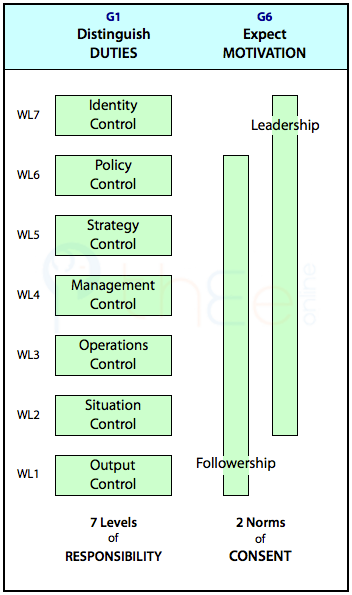
It is universally agreed that the central task for a leader is to determine a purpose to be pursued by a group and to follow that through in practice. But systems thinking requires that any entity is defined by a context-content relation. For leadership, if the content is the purpose or vision, then the context is the situation.
If we use systems thinking, then the leader is also required, implicitly if not explicitly, to specify the situation. Given that a purpose is developed to change the situation, the leader must be responsible for an account of the present as well as the desired future specified in the purpose. This notion is implicit in placing a requirement on a leader for a "strategic vision".
That is why belongs to the Change Domain where the different ways to specify a situation generate different forms of leadership, each with distinctive properties. Check it out.
 Skills & Mentalities
When leadership is taught, the essence (to enable change) is combined with a range of "skills" which typically include:
- character — integrity, trustworthiness, honesty, consistency, discipline, duty;
- competence — expertise, knowledge, skills, decision-making, problem-solving;
- communication — clarity, information, expectations, discussion;
- social skills — relationship-building, respect, tact, motivation, empowerment, conflict-resolution, flexibility;
- self-awareness — biases, triggers, weaknesses, strengths, presence, bearing, confidence;
- emotional intelligence — listening, empathy, compassion, guidance, mentoring, development;
- creativity.
Many of these are not skills, but forms of awareness which can only develop through sustained dialogue and reflection on experiences. Such reflection will likely reveal preferred mentalities or paradigms (value-systems) that are resistant to modification.
Reflection is difficult, and so leaders are advised to note the following:
- generate 8 different styles of leadership;
- The preferred will impact handling of responsibility, rationality, authority, social cohesion, attention to others, and more: see accounts in this section; and also see leadership challenges as part of career development.
- Social leadership is affected by the preferred as explained here.
Willingness: Invisible but Essential
Willingness is taken for granted in leadership discourses, but that may be due to a lack of understanding.
As explained at the outset, this structural hierarchy framework can also be viewed as a framework for "making a difference" or "rendering assistance": names not chosen because the full use of willingness is not always called for. The framework also elaborates what is meant by "being fully willing" as a controlling element in being creative.
Leadership is a situation where a maximum impact is commonly desired and where creativity is desirable. It follows that the full use of willingness is appropriate. So the structural hierarchy can be viewed as a framework of components for «», even if many components are left implicit.
However, until a reality is explicit, it is impossible to talk about it. Each grouping will now be taken in turn with some incomplete thoughts in relation to leadership.
G1: Instil Hope
appears to be the foundation of leadership. The need for confidence (the qualifier) and assurance (fortitude form) is often mentioned in leadership courses.
G2: Express Determination
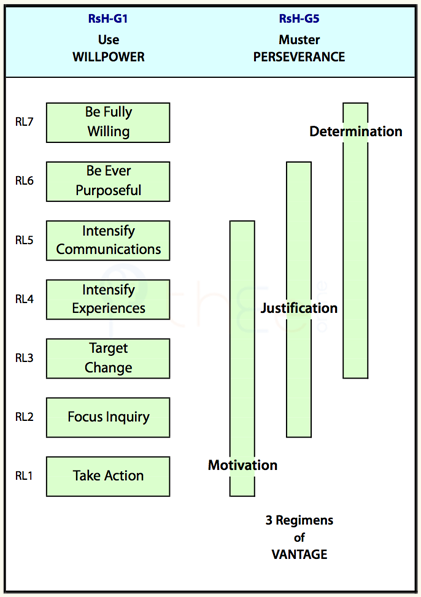
is located in the upper pentad in creativity: its lowest g1-level targets change and its highest g2-level requires being fully willing: click on thumbnail to see. While it is presented there as a way of mustering perseverance, it also manifests as .
G3: Develop Endurance
The inevitability of adversity and the likelihood of failure is mostly recognized in leadership programs. However, because of the glorification of leadership, some aspects get more attention than others.
G4: Mobilize Relationships
Relationships are a major focus in leadership programs. Putting time and energy into creating bonds with team members or followers is viewed as essential. The focus is typically on the personal dimension: consistency, concern, respect, support, empathy and such like. However, the focus in willingness is based on maintaining balance and is more general.
G5: Declare Capabilities
No one is a generic leader. To be a leader in a particular context to meet a particular challenge, it is essential to search your inner self and be clear that you possess the relevant capabilities. This also calls for be clear about missing capabilities that need supplementation by others.Details►
G6: Invoke Ideals
Ideals give form to leadership. The recognition of what ideals are relevant and the development of minimal standards for the group are critical tasks.
G7: Release Energies
is the ultimate spiritual attitude that is required. Here, leadership is the activation of all willingness forms in the service of leading others to meet their needs.
-
Back to the Review.
Originally posted: 12-Jun-2026.