Willingness & Interactions
This topic is an investigation that leads nowhere.
Seeking Benefit
When it comes to ensuring benefit, the explicitly requires a person to ensure their own security and interests in the light of existing power relations (v. Ch.6: Working with Values).
occurs as part of this search for benefit. All endeavours are about generating some benefit, directly or indirectly, and willingness can be expected to be strongly activated if benefit is assured.
The Q-expansion of the revealed that the 4th Q-complex (PH'6Q4) is focused on prospering, with the Q4-typology containing ways to interact for benefit.
There appears to be a correspondence between the 7 and the 7 , even using similar names in some places. But does this have any deeper significance?
 Reminder Table of Interacting Methods
Correspondence
Dropdowns allow you to think each correspondence through for yourself before seeing what is proposed.
, which involves making attempts where failure is possible or even likely, seems to have an affinity with ...
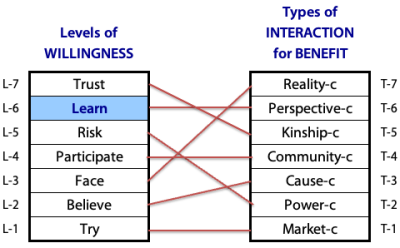
, which involves affirming an adopted viewpoint regardless, seems to have an affinity with ...
, which involves confronting reality regardless of how unpleasant or what others think, seems to have an affinity with ...
, which involves operating constructively within a social situation, seems to have an affinity with ...
, which involves entering undertakings for tangible gain and controlling the possibility of loss, seems to have an affinity with ...
, which involves acquiring knowledge and skills even if their quality and utility is doubtful, seems to have an affinity with ...
, which involves entering entering the new and unknown without any guarantees of safety, seems to have an affinity with ...
Differences
The ease of determining similarities may not mean much.
Willingness is the source of selflessness while the Prosperity frameworks are pressured by well-being and many other pressures because they lie deep within the Taxonomy.
Interacting-for-benefit is a self-interested egotistic act of will. Further taxonomic development leads to frameworks for financial security, social standing and looking out for yourself.
To be unequivocal:
is not necessarily money-based, commercial or market-oriented. Nor is it short term, or intrinsically competitive.
However, both and
interaction are driven by performance.
does not imply any ideology or any wish to change society. It does not call for sacrificing, for campaigning, for moralizing, or for a whole-of-life commitment around the belief.
is not focused on sustaining well-being, nor is there a necessary spiritual dimension. There is no requirement to grasp essences or unify disparate entities. Facing is utterly practical and deals with survival and meeting essential needs.
However, both and
interaction are driven by acceptability.
has no intrinsic concern for democracy or justice or the welfare of all with sharing of resources. The idea that everyone is equal and should be accepted as they are is irrelevant, and cooperation will only be sought if specifically required.
is directed to undertakings for tangible gain while minimizing risks. It views power-centredness as dangerous, because power-centred tactics like manipulation, physical force, threats, blackmail &c are actually very risky and generally not worth the gain.
does not necessarily demand multiple perspectives, and does not call for a holistic or systems viewpoint. Relativism and impartiality are not a requirement. Learning is most effective when narrowly and specifically focused on handling a particular skill or knowledge deficit.
seeks a feeling of safety but this is not an emotional matter, nor is it anything to do with traditions or ethnic roots, nor are wishes for frequent close contact appropriate.
Conclusion
This was worth checking out, and the linkage is undeniable. However, at this point, no deep significance or utility has emerged from this comparison.
NOT posted: