Checks for Hierarchy
PH7
Levels not Types
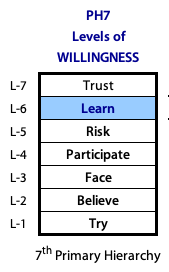
The elemental forms of willingness are offered not as "types of willingness" (as some might say), but rather levels as shown at right.
Whereas types in a typology can be presented in any order that is convenient for a particular purpose, hierarchies resist such handling. At least in THEE, there is far too much meaning tied up in the hierarchical ordering.
During formulation of the elements from L1 to L7 it was easy to imagine a natural linkage and upward flow.
 Example
A person to be part of an enterprise. During vetting and on joining the question of emerges, perhaps about how things should be done or where the enterprise should go.
Disputes amongst of believers are common. is a unifier that pulls people out of their silos and integrates them in a wider group for . Strength progressively develops within the enterprise at .
to the group framework encourages members to take as a way to progress, while being reassured the group can absorb failure.
By acknowledging were due to a lack of knowledge or skill, a person can engage in and commence remedying weaknesses. In choosing how to learn, a person must the methods and the teachers. On returning to the fray, in what has been learned can be activated for a new .
Below are some more formal reasons for believing in hierarchy, and the oscillation discussed in the next topic is highly persuasive. Since writing this page, additional frameworks (Tree, Structural Hierarchy) have been developed on the assumption that the hierarchy is appropriate, and that provides further validation.
Stratification
The study of forms of willingness, developed here and elaborated here, commenced from an assumption of hierarchy: the levels of will (root hierarchy) and its psychosocial pressures. So the layout would be expected to be hierarchical.
However, any postulate that the result is a hierarchy needs to be backed up by examining what was developed. Do the properties of the elements identified fit what might be expected in THEE?
An initial inspection of properties laid out in 7 levels reveals three strata:
Click to see a Table of Properties
-
In THEE, these levels commonly form a detailed foundation.• are all matters for the self to handle.
• Fears are about the ego's internal state and its inadequacy: causing humiliation, inner emptiness, receipt of criticism.
• Intervention to assist is about providing information: feedback, evidence, accounts. -
In THEE, these levels typically offer a more general perspective.• involve the social milieu.
• Fears are relational and focused externally on demands or harms.
• Intervention to assist is social and strategic. -
In THEE, these levels typically set the context or enable transcendence.• provide for open-ended potentials.
• Fears are about being disadvantaged, diminished or suffering a change to the self, even a disaster for the self.
• Intervention to assist is transformative and self-referential.
Cumulative Development
A cumulative approach is a classic signature of THEE hierarchies—each level may be self-sufficient, but it does not just replace the one below. It assumes, encompasses and transcends it by including lower level qualities while adding a distinctive new quality.
This was initially noted in levels of work (a Q-hierarchy) and subsequently used to discover primary hierarchies like this one (cf. inquiry; communication).
The cumulation should be evident in both Processes and Stances.
Processes
Based on the investigation so far, it appears that there is a cumulating pattern for the :
| L1 | Trying | calls for | Initiating | |
| L2 | Believing | calls for | Affirming | + initiating |
| L3 | Facing | calls for | Attending | + affirming + initiating |
| L4 | Participating | calls for | Submitting | + attending + affirming + initiating |
| L5 | Risking | calls for | Exposing | + submitting + attending + affirming + initiating |
| L6 | Learning | calls for | Altering | + exposing + submitting + attending + affirming + initiating |
| L7 | Trusting | calls for | Opening | + altering + exposing + submitting + attending + affirming + initiating |
Stances
This also appears to show a cumulative pattern for the :
| L1 | Trying | calls for | Resolve | |
| L2 | Believing | calls for | Insistence | + resolve |
| L3 | Facing | calls for | Forthrightness | + insistence + resolve |
| L4 | Participating | calls for | Joining | + forthrightness + insistence + resolve |
| L5 | Risking | calls for | Daring | + joining + forthrightness + insistence + resolve |
| L6 | Learning | calls for | Receptivity | + daring + joining + forthrightness + insistence + resolve |
| L7 | Trusting | calls for | Vulnerability | + receptivity + daring + joining + forthrightness + insistence + resolve |
Transitions Up & Down
THEE hierarchies have levels that can be seen to emerge from lower or higher levels to meet some functional requirement.
Example: The Levels of Purpose hierarchy emerges from the lowest level () by asking why? again and again until the highest level () is reached and the question loses meaning. At the same time, the hierarchy can be developed by starting at L7 and continually asking how? until the lowest level is reached and the question again loses meaning. See the full layout here.
The psychosocial challenge in appears to be summoning the inner energy while being firmly grounded so as to ultimately benefit.
The proposal for understanding the hierarchy is that:
transitions upward answer the question: how to be energized?
and
transitions downward answer the question: how to be grounded?
Starting from below:
is the foundation of because the readiness to initiate action re-occurs at every higher level.
Q: How can trying be energized?
A: By adopting relevant ideas that are emotionally charged
i.e. move up to .
Q: How can believing be energized?
A: By directly connecting beliefs to the reality relevant to your needs
i.e. move up to .
Q: How can facing be energized?
A: By getting well-deserved social support
i.e. move up to .
Q: How can participating be energized?
A: By increasing the possibility of gain
i.e. move up to .
Q: How can risking be energized?
A: By addressing weaknesses in relevant abilities.
i.e. move up to .
Q: How can learning be energized?
A: By overcoming fear, uncertainty and doubt about the unknown.
i.e. move up to .
is the pinnacle for energy.
There is nothing more: you just have to trust!
But if you want to energize it, then something.
Starting from above:
is the pinnacle of because it reflects a readiness to enter the unknown for undefined benefits, despite possible exploitation and betrayal.
Q: How can trusting be grounded?
A: By obtaining knowledge and skills relevant to the situation.
i.e. move down to .
Q: How can learning be grounded?
A: By finding situations where the knowledge can lead to gains.
i.e. move down to .
Q: How can risking be grounded?
A: By being part of groups where you get support.
i.e. move down to .
Q: How can participating be grounded?
A: By recognizing how and where contributions can be made.
i.e. move down to .
Q: How can facing be grounded?
A: By using values and assumptions to direct efforts.
i.e. move down to .
Q: How can believing be grounded?
A: By applying them so as to generate beneficial results.
i.e. move down to .
is the ultimate ground.
There is nothing more: you just have to try!
If you still want deeper engagement, then .
The evidence is now strong that a typical THEE hierarchy has been identified. However, a striking characteristic of THEE hierarchies is the difference between odd- and even-numbered levels.
- Search for a duality that oscillates from level to level.
Originally posted: 3-May-2026. Amended: 27-Jun-2026.