Instruments of Control
Rationales and Influence
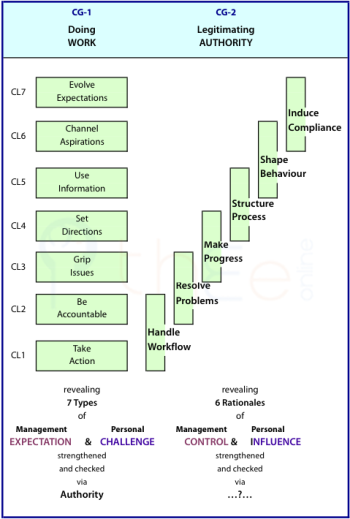
Autonomy is so important for a person to work in a creative and committed way. So any intrusion or control requires a legitimate rationale. There are six distinctive rationales. Each corresponds to a Dyad formed by combining adjacent levels in doing work-CG1 (click on icon to enlarge) i.e. adjacent means of achieving..
 Reminder of the Rationales
The lower three rationales are practical:
■ Handle workflow (CG21)
■ Resolve problems (CG22)
■ Make progress (CG23)
The upper three rationales are psychological:
■ Structure process (CG24)
■ Shape behaviour(CG25)
■ Induce compliance (CG26)
Because people vary in the influence they can bring to bear, it seems that each of the rationales can be handled via:
- a stronger instrument, &
- a weaker instrument.
So there are 6 pairs of instruments. These universally recognized and immediately recognizable instruments are introduced briefly below and explored in more depth in the next Topic.
Legitimate Rationales for Authority
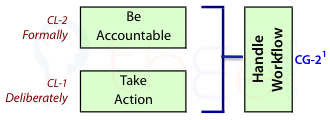
Handle Work-Flow: CG21
In an organization there is a continuous flow of work that must be handled. So, if an organization is to function, it requires staff to take on social roles in which they formally accept CL2-accountability and deliberately take all necessary CL1-actions.
Relevant Virtue: Dependability.
Stronger Form: Manage ►
The manager comprehensively orchestrates his own work and that of subordinates to deliver the maximum output. He is preoccupied with the performance and development of his subordinates.
Weaker Form: Administrate ►
The administrator punctiliously processes work demands, and allocates tasks to subordinates according to their duties and current pressures.
Key Factor: Culture ►
Success or failure depends on the developmental stage of the management culture. Dysfunctional pragmatic cultures with fuzzy roles, ill-defined authority, power-centred staff and confused hierarchies can render these instruments virtually unusable. In such organizations, rules are broken routinely; failures to act (or think before acting) lead to crises; procedures and systems are defective.
Resolve Problems: CG22
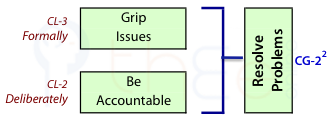
Operations never run smoothly and so organizations require staff to take on social roles that directly fix whatever disrupts the flow of work.
Relevant Virtue: Helpfulness.
Stronger Form: Troubleshoot ►
The troubleshooter is prepared to take a view of impediments or disruptions that is as broad and as deep as is required by the issue.
Weaker Form: Supervise ►
The supervisor limits their view of any issue to accord with their pre-defined remit. As a result, they often fix an immediate problem in a temporary way or by displacing it elsewhere.
Key Factor: Systemic View ►
Success depends on the ability to take a systemic perspective on the issue. But that is inherently difficult. So staff often ignore the issue (i.e. turn a blind eye, put it into the «too hard» box). If the issue is directly disruptive, then the affected person may devise their own work-around that substitutes for a resolution and has more or less dysfunctional effects.
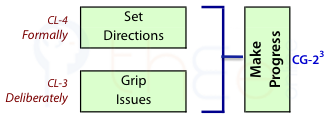
Organizations require staff to take on social roles in which they organize relevant staff so as to enable them to pursue certain goals as a unified group.
Relevant virtue: Trustworthiness.
Stronger Form: Lead ►
The leader spearheads the group so as to take them where they may not initially or individually want to go.
Weaker Form: Coordinate ►
The coordinator operates as a first among equals to take the group where the members come to agree they should go. Coordinative authority can be specified.
Key Factor: Leadership Style ►
Leadership «authority» cannot be specified. So success depends on the style of leadership of the person expected to oversee the direction of the group. It is not suggested that one style fits all cases. If the style is ineffective in the situation, then strategic development will certainly be weak; problems are likely to emerge and persist, leading to stagnation or serious failure.
Structure Process: CG24

Organizations require staff to take on social roles in which they enable implementation of a defined change in a controlled way.
Relevant Virtue: Assertiveness.
Stronger form: Project-manage ►
The project-manager organizes, closely controls resource use, and monitors implementation so as to complete a project to the quality specified, on time and within budget.
Weaker form: Plan ►
The planner sets priorities, identifies the goal, and specifies the logical steps to reach the goal. (The planner leaves it to others to implement the plan and may offer little more than monitoring.)
Key Factor: Systematic Methods ►
The crucial issue is the staff's willingness to use systematic methods of deciding and working. In their absence, which is usual in pragmatic cultures, plans go astray and get disrupted by emerging crises and urgent (but unimportant) pressures.
Shape Behaviour: CG25
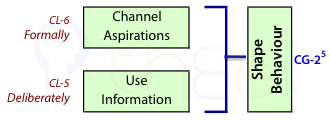
Organizations require the more senior employees to reinforce what is desired and discourage what is unacceptable at work.
Relevant Virtue: Attentiveness.
Stronger form: Reward or Punish ►
Rewarding or punishing taps into common aspirations. They are not always immediately obvious to all, but they are tangible and potentially noticeable within the organization (e.g. via promotion/demotion; perks, like a larger office). Use of the instrument will usually be known to some others (e.g. finance if a bonus, or HR if a re-grading).
Weaker form: Praise or Criticize ►
Praise or criticism can be verbal and personal. Often, no-one but the two people involved will know about it. It may sometimes be appropriate that praise be given in public and criticism given in private.
Key Factor: Fairness ►
The key factor is the fairness of the reward/praise or punishment/criticism, especially as judged by others in the organization. Cultures may develop in which either the positives are neglected or the negatives are far too muted.
Induce Compliance: CG26
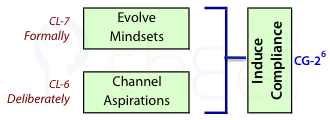
Organizations require employees, irrespective of seniority, to make quasi-formal conditional commitments about an uncertain future e.g. to break a deadlock, or circumvent difficulties, or engender a particular course of action.
Relevant Virtue: Strength.
Stronger Form: Impose ►
Imposing involves forceful assertions backed by powerful explanations so as to induce a change in the mindset of the listener. The listener can then deliberately alter an aspiration to suit the situation. Usually thought of as a tool for superiors, it can also be used on them by subordinates with a strong character and perceptiveness to match.
Weaker Form: Promise ►
Promising uses the force of seduction by creating a sense that benefit will flow in due course if only the listener will agree to think differently and deliberately alter their aspirations. Again it can be used by both superiors and subordinates on each other.
Key Temptation: «Get Your Way»
Managers, especially at senior levels, are tempted to induce compliance in ways that weaken autonomy and responsibility of others. This CG26 instrument lends itself to crude power-plays (threats, intimidation, bullying, humiliation) and devious manipulation by pragmatic operators. It just seems so quick and easy to get «cooperation» that would otherwise not be forthcoming. The difference is that compliance occurs mechanically, without any change either in mindset or aspiration. Such compliance will never produce a creative output. Promises are often not delivered for other reasons: the pragmatist leaves the post, or excuses himself in terms of changing circumstances or unexpected pressures.
Key Factor: Credibility ►
The key factor in whether you get away with imposing or promising is how convincing you are. Being genuine is not enough: the recipient may or may not be convinced. In other words, credibility is more important than status or expertise or defined authority. You may have to demonstrate that you really mean what you say. How would you do that? Unless you control the person's future as a line-manager, it will be rather difficult. Even then, it may not be easy.
Note: If the promise was a written quasi-legal guarantee then it would be an incentive at CG71 and not a matter of influence at CG2.
Go deeper:
Originally posted: 20-Oct-2011