Research Styles
Methods in THEE's Primary Domains can be operated in 4 different ways or styles which are in a hierarchic order. See further architectural details here.
Recognizable labels can be assigned to particular types of inquirers or forms of inquiry in relation to these styles. All labels and suggestions are provisional at this point.
This follows on from a briefer analysis in the Architecture Room.
Empirical Method (L'1)
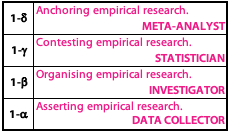
need simply to the value of the empirical approach. By contrast, who control the data and its analysis must any empirical research project. Once data has been collected, its significance is by to determine confidence levels and probabilities that findings are due to chance. Finally, empirical findings are by the work of who bring together available studies for deeper statistical and qualitative study.
Analytic Method (L'2)
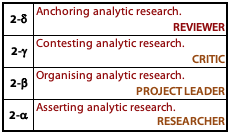
typically what their findings mean via qualified conclusions and speculations. However, a more experienced investigator acts as an and the analytic effort in light of the literature and a variety of possibilities. This ensures a coherent and reflective "Discussion" section in publications. Whatever the analysis, there will be who the conclusions reached. Finally, every field of study provides for to the analyses by producing reviews based on multiple recent papers and integrating them with findings in earlier studies.
Explanatory Method (L'3)
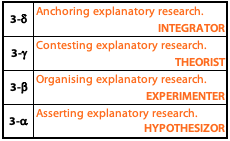
simply a particular explanation, perhaps as part of an analysis refuting a colleague's conclusions. go the next step and the testing of the hypothesis either to verify or falsify it. Whatever the findings, there will be who the conclusions by drawing on alternative theories. Finally, explanatory research is ultimately by who check out multiple alternatives and ensure that any confirmed explanation fits within an acceptable theoretical paradigm.
Dialectic Method (L'4)
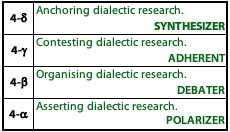
simply the existence of a conflict within the inquiring field. However, it requires a to the inquiry by clarifying the nature of the conflict and the arguments supporting each position. to one side or the other polarization, typically wishing to nullify the opposition. Insofar as both sides have adherents, the research is by a who explicitly validates both sides and shows how they are embraced within a single larger conception.
Holistic Method (L'5)
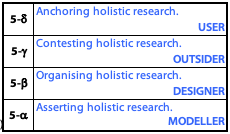
holistic research because whatever they see is a pattern of objects in relation to other objects i.e. a model. take models provided or developed and them to fit particular situations so as to enable specific change or goal-driven activity. Participants contribute to model development and design, but as have no stake in the model while seeking to apply it. So they are the ones who validity. Finally, the model by adopting and applying it on a regular basis.
Formal Method (L'6)
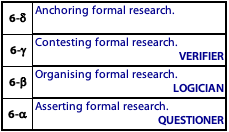
Formal research starts by a an abstract question or statement deemed worthwhile addressing. are then required to the inquiry, setting the proof out in clear steps that permit checking that no rules are broken. The proof should be verifiable, so can and must the arguments and assumptions. Having passed that test, formal outputs are by and become part of the disciplinary canon.
Contemplative Method (L'7)
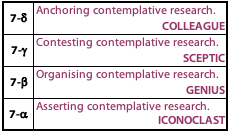
The contemplative method is required when anomalies and issues in the current paradigm are intractable. Experienced scientists act as and that knowledge is in a parlous state. However, it requires a to be able to look at the world in a new way and an inquiry. quickly arise to the new conception. If it passes their tests, then a emerges to the insight by re-stating, confirm and further developing its value.
Example from Physics:
-
Now proceed to naming the Levels of informed knowing.
Originally posted: 21-May-2023.