Transforming Leadership
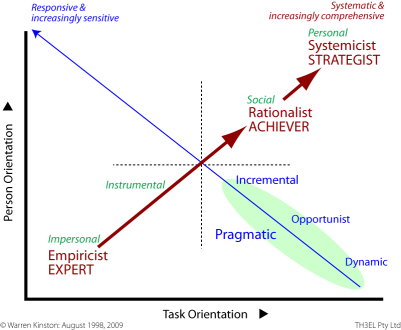
R&T's article is titled: Seven Transformations of Leadership — but they only describe three transitions in detail:
● Expert ► Achiever
● Achiever ► Individualist
● Individualist ► Strategist
Only one of these is convincing; and a possible transformation is omitted.
Expert ► Achiever
The most understandable move is from being an Expert to becoming an Achiever. But antagonism between diagonally opposite quadrants is usual in a TET. This is evident here because the transformation means moving from an impersonal approach to a social approach. This would be very hard for an Expert.
However, a Expert might be able to take up the organization with its values and goals as their «». That could definitely assist in developing the Achiever-style of leadership.
 An Omitted Transformation
Achiever ► Strategist (i.e. ignoring the Individualist stage)…
Another general rule in a THEE TET is that types within a quadrant have an affinity, with the more extreme type seeming more sophisticated, and therefore possibly desirable.
As shown, both Achiever and Strategist share a quadrant, and some people would desire to make that transformation. To detour them via the Individualist makes little sense.
Highly Improbable Transformations
Achiever ► Individualist
The difference in awareness and sensitivity is so great that . Reality-centredness tends to be anti-leadership and is often viewed as anti-organization: as one perceptive CEO explained to a person: «You have to go despite, or rather because of, your many achievements here.»
R&T's text reflects a well-meaning ignorance of what is likely to be going on in Sharon's mind. The CEO's mentality as an Achiever is likely to have difficulty appreciating Sharon's perspective: e.g. someone like Sharon might well initially attend to the CEO's carefully coached speech. However, she starts thinking that it goes on too long. Soon boredom and irritation with its propriety and niceness would set in. As the encouragement proceeded, a sense of frustration would grow inside her until an experience of contempt would erupt and need suppression to maintain politeness. Either fidgety movements or impassivity would occur, while unvoiced internal thoughts would be advising her to exit the organization even sooner than planned. (Whatever conversations might have actually taken place, Sharon did soon leave.)
Individualist ► Strategist
This is also an unlikely move. The Strategist is an that does not allow for quick and easy identification by others, and offers no inducement unless the potential already exists—as it will in some proportion of cases. In practice, a person may (or may not) have the capacity to work as a Strategist. The two identity states are in distinct realms of human functioning.
THEE's Approach to Transformation
► Do You Really Want to Transform?
► How Does Personal Transformation Occur?
► Do Organizations Need to Transform?
► A THEE-Eye View of the Future
- We are at the end of this Exercise: it is now time for a wrap-up Report Card.
Last Updated: 12-Jan-2012