Consciousness & Endeavour
The «Hard» Question
Q: Why do we possess consciousness?
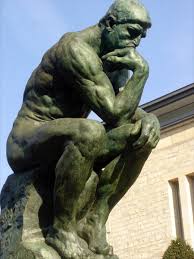
Consciousness is the current focus of much scientific debate and research—while endeavour, our biological competitive advantage, is not. Human consciousness, in the sense of our reflective awareness, is viewed here as an essential component of endeavour. So studying consciousness in isolation is to take it out of its natural setting. More
In the Taxonomy, alertness (rather than sleep or coma) is assumed, so the degree of consciousness is not relevant. All attention is given to what can come into awareness as part of a classification effort. So, the Taxonomy does not examine the «how» aspects of consciousness (i.e. how represented in the brain), but the «what» i.e. mental experiences.
No position is taken on the 'hard' question of consciousness for neuroscience and philosophy. However, the Taxonomy has generated a variety of reasonable conjectures that lend themselves to neuroscientific study. To benefit from this website, these conjectures are far less important than the Taxonomy itself.
The Role of Consciousness
Q: If consciousness is needed for endeavour, what role does it play?
Achievement itself does not require conscious awareness. If you drive often to work, you can safely arrive there without consciously attending to every action. But try driving to a place that you have never visited before: you pore over maps, use a GPS, slow down to peer at road signs. You are fully aware during your trip because you must consciously sense and think to arrive safely.
So purpose (a taxonomic element) itself is not part of consciousness, but it can be brought into consciousness (as an idea) if it is part of an endeavour. An action is not necessarily in consciousness either, but it can be experienced in advance (as an image) and while it is occurring (as sensations). There are other forms of experience, each with their own contribution to endeavour. The central element of conscious experience generated by the mind is an inner continuity and coherence that we call «the self». The «sense of self» is what makes me experience my endeavour as mine, and you experience yours as yours.
Only through our mental experience can we be aware of elements of endeavour so as to share and evaluate them. The Taxonomy was initially envisaged as covering the human elements of endeavour (hence: THEE). But it could have been referred to as a Taxonomy of Endeavour Elements in Awareness (TEEA), or a Taxonomy of Experienced Personal Functioning (TEPF).
Research Strategy
This research project started by identifying elements in endeavour to help people who were confused about what they were doing. Once the taxonomic architecture was established, it became possible to trace it back to biological properties of the organism—and to ask which neural circuits or brain states might support such structures.
The taxonomy elements are observable. Observations can be replicated and errors corrected. Taxonomic regularities and principles are checkable. By contrast, the biological infrastructure is currently conjectural. These conjectures need testing, which is a more complex process involving methods of neurophysiology or comparative biology.
- Consider the social context of this discovery.
Originally posted: 14-Jan-2014. Last Updated: 7-Nov-2026.