Significant Commitment
Engagement with the challenge as been triggered. Participation and the lower Centres that ensure a practical involvement have been identified. However, given the many obstacles and difficulties, participation requires bolstering.
Psychosocially, this occurs through viewing participation as significant and making a commitment to see things through. This immediately entails , and sooner or later from mistakes and failure. Finally, commitment means that you yourself and others.
L5: Risking
As soon as is activated, the question that emerges is what am I risking and what gains or losses are likely. Risking for gain will buttress my involvement if it is within my risk tolerance.
Centre(s)
Dynamic Duality: Risking generates two polarized Centres in the Tree: and .  Why?
Why?
We will label :
and label :
Channels
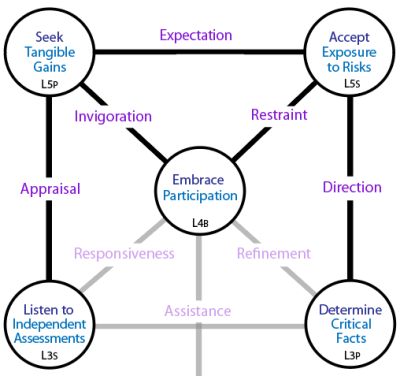
Tolerating risks () will dominate over seeking gains (), because if the risks cannot be tolerated, willingness rapidly diminishes. So the Centre is placed on the right side of the Tree. A channel between these two is necessary.
Risks are only tolerable if you expect gains, and when you seek gains you expect that some risk is unavoidable and must be tolerated.
is provisionally labeled Expectation
The presence of risks will restrain participation, and because participation involves others, it will restrain the taking of risks.
is provisionally labeled Restraint
The potential presence of tangible gains makes participation seem worthwhile and fosters effort. Conversely participation energizes a search for gains as an incentivising by-product.
is provisionally labeled Invigoration
is closely related to realites that must be .
With regard to the avoidable risks that must be tolerated, your determination of crucial facts is what counts. The realities that you identify should help clarify your exposure to risks. Any unavoidable risk that you have to accept will direct you towards realities that should be faced.
is provisionally labeled Direction
However, tolerance to risks has no direct relation to independent assessments or vice versa. WHY?
Independent assessments of the challenge will orient you to the potential for gains. The search for gains will orient you in listening to what others may say about the challenge.
is provisionally labeled Appraisal
However, seeking tangible gains has no direct relation to the determination of crucial facts or vice versa. WHY?
and do not impact on directly, but they may generate effects if mediated by intervening Centres. similarly require to be mediated by or in order to affect or
L6: Learning
The willingness to embrace a challenge rapidly runs into the possibility that a weakness will be exposed. You are liable to find that you lack a specific skill or necessary knowledge. This must be remedied.
Centre(s)
Dynamic Duality: Learning generates two polarized Centres in the Tree: and . Why?
We will label :
and label :
Channels
will have the dominant influence because they are definitive. So it is placed on the right side of the Tree.
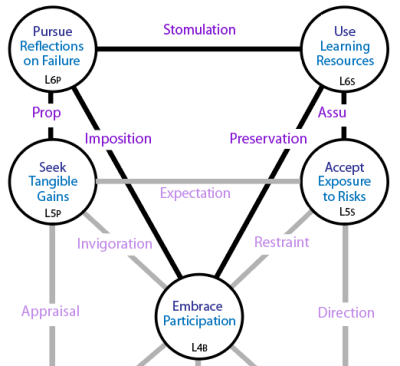
is provisionally labeled Impr
sgasas
lj;lk;lk
is provisionally labeled Ch
asdfasdfsadf
oiuuioiipu
is provisionally labeled Ch
fgsfdgsd
asdfasfd
is provisionally labeled Orn
asdasdf
is provisionally labeled Change Pressure
Neither pole will attempt to address specific , or ) without mediation by the and institutional
L7: Trusting
Centre(s)
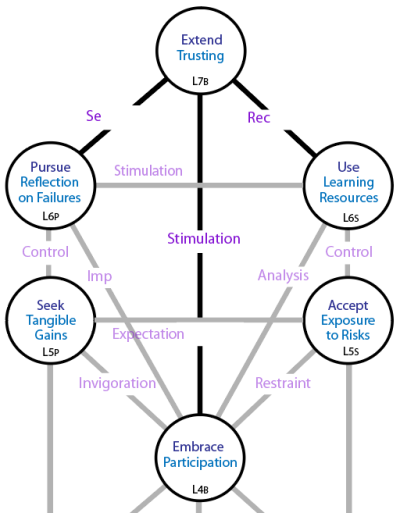
Dynamic Duality: In all cases, there is a fusion of personal and socio-situational factors.Why?
So, in the Tree, this level becomes a single balanced Centre: .
We will label :