Re-enter Mode-1: Self-Containment
The Watershed
Having reached the (Stage-4), the is now strong—strong enough to refer confidently to "a self". A person feels well-individualized. Because of the values and attitudes that have cumulated to this point, the quality of the now shifts.
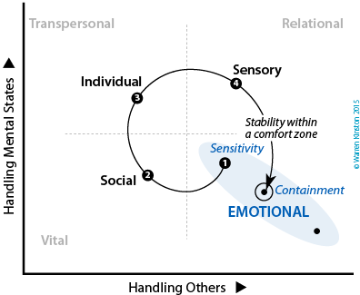
Less attention needs to be given to handling mental states because:
- social integration in provides automatic conventions and norms that modulate and channel feelings;
- the self-concept in provides a base for social orientation and self-direction as well as a preference for keeping feelings private; &
- a flow of positivity including friendly and reassuring recognition is received in .
At the same time, the cumulation of values from the and makes it easier to handle events of all sorts.
So the spiral trajectory re-enters the further down the ellipse. This new position is best characterized as . of feelings, or , is a state in which the self is both sensitive and stable.
The boundaries within which stability is assured define a «comfort zone». Outside the comfort zone, a person is liable to become overtly and even intensely emotional—which is why people do not want to leave that zone.
The initial values of the now manifest a subtle but significant adjustment due to inputs from .
- now generates far less volatility.
- becomes less urgently desired.
- are less depended on.
- occurs with less intensity.
- involves more diversity.
- are more durable and dependable.
- is aided by self- and social-acceptance.
Having provided satisfactory control of one's own , the completion of is an attractive settling point in the self-strengthening process.
Recap of Cycle-1
The function of Cycle-1 is to ensure that a person has sufficient control over their —while being and feeling wholly themselves in a distinctive way.
 Recap how this control develops:
At each of these 4 , a person may feel content with their self and its degree of strength and individuality. If so, there is no call for further progress. Such a choice will depend on situational factors (e.g. age, community), as well as personal aspirations and, perhaps, the preferred .
While at the end of can exist and function in a constructive, comfortable and balanced fashion, something more is possible. allows exploration and activation of these additional personal potentials.
Significance & Meaning in Cycle-2
There is more to life than stability. Many find that an inner drive for well-being calls for the self to become more meaningful in personal and social terms.
If well-being is to become more meaningful, then the 'self' must become less 'selfish'. That means raising one's horizons and making a special effort.
through calls for understanding and reflection: it is a process that can be termed: self-actualization. It requires a willingness to alter belief systems and to step outside comfort zones.
Exploring and developing inner potentials is a multi-stage process. The first step is to become energized for greater things and this can only emerge from values inherent in .
Preview Development in Cycle-2
■ involves moving back along the X-axis to the and getting energized by vigorous engagement with something challenging beyond usual expectations.
■ involves opening up to the cosmos so as to perceive meaning in all events and people via the , and allowing that focus to affect and develop the .
■ allows a return to one's more worldly self in the but now ensuring that is assigned a special meaning and unique value.
■ This then leads spontaneously to a return to the , but at the far lower right extreme of the ellipse where the handling of feelings is via .
- Move to Stage-5: Vital mode.
Originally posted: 7-Jan-2016. Last amended: 7-Nov-2026.